Results matching “first”

News Scan

Illegal Immigrant Charged with Rape, Kidnapping:  A twice-deported Honduran illegal immigrant was formally charged this month by federal prosecutors for kidnapping his estranged girlfriend and repeatedly raping her at knifepoint during a trip from Missouri to New Jersey.  The AP reports that last May, 30-year-old Jose Amaya-Vasquez kidnapped the woman from a Kansas City parking lot and assaulted her repeatedly in Missouri, Pennsylvania and New Jersey as they traveled with their two-year-old child in tow, holding her against her will by threatening to kill her three children and mother in Honduras.  Amaya-Vasquez first entered the country illegally in 2005, but wasn't caught and deported until July 2014.  He was caught again two months later attempting to reenter the U.S. through Mexico, served 30 days in jail, and was deported and barred from reentering for another 20 years, an order he ignored.

Baltimore Police Begin Wearing Body Cams:  Baltimore equipped over 150 of their police officers with body cameras on Monday as part of a two-month pilot program to test cameras from three vendors before one is chosen for citywide use beginning next year.  Kevin Rector of the Baltimore Sun reports that officers have been instructed to activate their own cameras prior to citizen interactions and upload the footage to a cloud-based storage.  The department decided not to release the program's "draft policy" that was developed to determine how and when officers use their cameras, how officers can respond to citizen requests not to be filmed, how the department plans to use the footage and who will have access to the footage, leaving some citizens concerned over the lack of transparency.  Ultimately, city officials and citizens agree that equipping Baltimore's officers with body cameras will be an asset to the department by helping to "ensure fairness on each side."  It will take approximately two years to equip the city's 3,000 rank-and-file officers.

Police Officers Alerted to Possible Halloween Ambush:  The Federal Bureau of Investigation issued a bulletin to police departments in cities across the country warning that an anarchist group may be planning to ambush officers on Halloween.  Fox News reports that the group, called the National Liberation Militia, encouraged its supporters to create disturbances to lure law enforcement and then attack them ambush-style, in what they dubbed a "Halloween Revolt."  In New York City, where tensions are high after last week's fatal shooting of a police officer and the anti-police rally that followed, NYPD is monitoring the threat.

CA High Court Upholds Death Penalty in 1979 Murder:  The California Supreme Court unanimously upheld the murder conviction and death sentence on Monday of a man who raped and strangled an eight-year-old San Pablo girl in 1979.  The Contra Costa Times reports that 71-year-old Joseph Seferino Cordova was arrested in 2002 for the rape and murder of Cannie Bullock when a cold hit DNA match linked him to evidence found in the girl's body over two decades earlier.  He was convicted of murder and sentenced to death in 2007.  In Cordova's appeal of the murder conviction, he argues that there was an unfair delay in the prosecution because authorities should have suspected him sooner, as he was convicted in Colorado in 1992 for attempted sexual assault on a child and again in 1997 for sexual assault on a child.  That argument was rejected by the California high court on the basis that investigators possessed no evidence connecting Cordova to the crime until the 2002 cold hit.  His challenges to the use of the DNA evidence were also turned down by the court.  He will continue legal challenges to his conviction in the federal court system.
Comey: The "Chill Wind" Driving the Murder Spree

When President Obama announced his appointment of Jim Comey to be FBI Director, he was greeted with wide acclaim, including from me.  Comey's intelligence, experience and  --  most importantly for that position, independence and political neutrality  --  won him plaudits from all over the spectrum.

In a talk at the University of Chicago last week, Comey showed all his best traits, especially his independence, when he came out and said what many entries on this blog have said:  That ramped-up public snarling at the police has an intimidating effect, and that when the police are intimidated, crime goes up (which is exactly what has been happening for at least six months).

Thus, as Reuters reports:

Murder rates are soaring this year in many U.S. cities partly because police are holding back from aggressive tactics, fearful of being taped on smartphones and accused of brutality, FBI Director James Comey said on Friday.


Is the Sentencing Reductions Bill "Popular"?

Roll Call has this headline today:  "Popular Criminal Justice Bill Poses Political Risk."

The headline is partly correct for reasons the story mostly fairly reports:  There is to say the least no guarantee that the thousands of criminals who will be released early under this bill will not create more harm when they get out. When this happens, the "risk" is that electorate might want some accountability from Congress. (Accountability is usually touted by liberals as a good thing, but not so much in this context.  Here, it has turned into the return of Willie Hortonism, as the story makes clear).

But the first word in the story's headline is questionable at best.  Who says this bill is "popular?"  And with whom is it popular?

I'm sure it's popular with the serious criminals now serving sentences who will benefit from it.  I'm sure it's popular with George Soros and others on the far Left.  But is it popular with the American people?

Why don't we do a fair poll to find out?  The question would read:  "Congress is considering a bill that would increase the discretion of sentencing judges and lower sentences for some kinds of drug dealers, saving prison space.  The bill would also result in the early release of thousands of drug dealers previously convicted, hundreds for heroin and methamphetamine.  Do you favor or oppose such a bill?"

Does anyone here wonder why the sponsors of this bill have not commissioned such a poll?  Right you are!
At the Senate hearing on the Grassley-Durbin sentencing reductions bill a week ago, Paul Mirengoff picked up this quite revealing moment:

[T]here was an interesting exchange regarding where James Comey, the head of the FBI, stands on this bill. During her testimony, Deputy Attorney General Sally Yates seemed a little cagey on this subject. So Al Franken asked her flat out where Comey stands (it took him two shots to ask this coherently -- Yates had to ask him for clarification after his first attempt).

Yates answered that Comey supports "the goals of sentencing reform."

Well, yes, I too support the "goals of sentencing reform," if those "goals" could be said  --  as they could  --  to bring about (1) a better world, (2) a peaceful life for everyone, and (3) the advancement of wonderfulness.  

It's not difficult to translate what Ms. Yates was actually saying.  If Comey truly backed this legislation or anything like it, she would have reported his position as, "I am happy to tell you that Jim Comey enthusiastically supports this bill, with at most quite minor modifications."

Her much different answer said a lot, however.  My guess, after a few years as a political appointee at DOJ and a longtime Beltway observer, is that the actual answer is, "Comey can't stand this bill because it's dangerous and it guts much of what he worked successfully to achieve as an AUSA, but he's keeping it zipped out of loyalty and political prudence."

Thoroughly Justified Homicides by Police

 Amy Brittain has this story in the Washington Post.  It's bottom line should not be news -- everyone should know this.

To identify trends among fatal shootings by police, The Post studied whether the individuals killed were unarmed or armed with weapons and reviewed the actions they took in the immediate moments before police shot them. The Post has compiled a database of all fatal shootings nationwide by officers in the line of duty in 2015.

[The story describes the case of bank robber Steven Snyder and Trooper Trevor Casper, who shot and killed each other, Snyder firing first.]

But only a small number of the shootings -- roughly 5 percent -- occurred under the kind of circumstances that raise doubt and draw public outcry, according to an analysis by The Washington Post. The vast majority of individuals shot and killed by police officers were, like Snyder, armed with guns and killed after attacking police officers or civilians or making other direct threats.

Jim Pasco, executive director of the national Fraternal Order of Police, said The Post's findings confirm what police officers already know.
Why doesn't everyone already know that?

A Preview of the Bloody Reach of Sentencing Reform

This story gives us a glimpse of the future if sentencing reform passes.  It is not pretty.

The under-incarceration problem manifested itself again this week. Tyrone Howard is a 30-year-old criminal with 16 prior arrests, mostly for drug offenses, and 12 prior incarcerations. He stands accused of shooting NYPD officer Randolph Holder in the head, killing the officer.

Howard's most recent arrest occurred a year ago on a drug-related offense. Despite his long record, he served less than six months before being released into a "drug diversion" program [Ed. Note: for which he never showed up, as Kent noted in the previous post]..

Even New York's leftist mayor Bill de Blasio admitted that Howard should not have been on the street.

But the judge who released Howard, Edward McLaughlin, disagrees. He has defended his decision, which was based on the theory that Howard's previous offenses did not involve violence. Judge McLaughlin admitted he was unaware that Howard had been linked to a 2009 shooting that left three people wounded.

This case illustrates the problem with giving judges the discretion to let criminals off easy. Which brings us to the Sentencing Reform and Corrections Act of 2015. 

News Scan

Ohio Halts Executions Until 2017:  Executions in Ohio are to be delayed until at least 2017 to give prison agencies extra time to secure supplies of hard-to-obtain lethal injection drugs.  Andrew Welsh-Huggins of the AP reports that warrants of reprieve were issued by Gov. John Kasich, allowing executions dates for 11 inmates scheduled to die next year and one scheduled for early 2017 to be pushed back through August 2019.  Franklin County Prosecutor Ron O'Brien expressed his disappointment in the push-back, stating that "these delays come in cases where inmates have long exhausted their appeals and there's no question of their guilt."  Strict supply and distribution restrictions implemented in recent years have made it extremely difficult for death penalty states to secure the proper lethal injection drugs.  Both Oklahoma and Arkansas also halted executions in recent weeks amid investigation and legal challenges.  Update:  A follow-up AP story is here.

Anti-Sanctuary City Bill Faces Key Senate Vote:  The White House threatened to veto a Republican-backed bill that would make it illegal for local governments in so-called sanctuary cities to ignore federal immigration detainers, and would withhold federal funding from cities that fail to cooperate.  Fox News reports that the veto threat of the Stop Sanctuary Cities Act comes ahead of a Senate test vote Tuesday afternoon.  The legislation needs 60 votes in order to advance, meaning that at least a half-dozen Democrat senators must vote in its favor.  In a written statement, the White House claims that the bill fails to offer comprehensive reforms to fix the U.S.'s broken immigration laws, but GOP backers argue that the new legislation is a first critical step toward combating the dangerous practice of ignoring federal immigration law.  The bill comes three months after 32-year-old Kate Steinle was shot and killed in San Francisco by an illegal immigrant with a felony record and five deportations.  San Francisco is just one of hundreds of sanctuary cites in the country.

Update:  The bill was blocked by Senate democrats on a 54-45 vote.

Heather MacDonald Argues Against Sentencing Bill:  Powerline blog has this post by John Hinderaker discussing Manhattan Institute Fellow Heather MacDonald's testimony before the Senate Judiciary Committee opposing S2123, a proposal to reduce federal sentences, which would result in the release of a large number of federal felons.  In her testimony Monday, MacDonald notes that the national narrative claiming that the U.S. prison system is irrationally draconian and racially biased is false and reinforced by a misconceived war on drugs.  She argues that racism, the war on drugs and police officers are responsible for neither mass incarceration nor any disproportionality of blacks in prison; violent crime is.  In her closing statement, she implores the committee to do the public a great service by rebutting the myth that the criminal justice system is racist.  The video recording of her testimony is available in the link provided.  The full hearing is on C-SPAN.

Why the Rush?

I did not attend today's hearing on the Senate's sentencing reform legislation because I suspected it would be going through the motions.  This post by my friend (and co-author) Paul Mirengoff confirms my suspicions.

The question about this bill, said by its authors to be "the most significant criminal justice reform legislation in a generation," is  -- why the rush?  As Paul notes:

[T]he Committee saw fit to hold only three hours of hearings on [the bill]...,Moreover, the hearings took place on the Monday after a long recess, a nearly unprecedented move by the committee that minimized the number of Senators who were able to attend. By my count, only 11 Senators participated. The Committee has 19 members.

I suspect the rush is for two reasons.  First, the (essential) Republican sponsors are backing this bill holding their noses, for reasons Chairman Grassley himself cogently explained when he was on the other side of this issue less than a year ago.  Second, as Prof. Doug Berman has noted (in quite different language from the words I am using), as the streets of Washington, DC, and other major cities become bloodier and bloodier with escalating crime, "...the window for any meaningful federal sentencing reforms emerging from Congress is already starting to close."

No kidding.

News Scan

Officer Killed by Injured Suspect in Hospital:  A sheriff's deputy of a small Minnesota town was killed early Sunday at a St. Cloud Hospital when an injured suspect being treated there grabbed his gun and shot him.  Fox News reports that 60-year-old Steven Martin Sandberg of the Aitkin County Sheriff's Department was asked by the hospital to monitor 50-year-old Danny Leroy Hammond, a suspect charged with kidnapping, assault and terroristic threats against his wife and being treated for an undisclosed condition at the hospital.  A struggle ensued between Sandberg and Hammond, who was not handcuffed, and several shots were fired before security guards entered and subdued Hammond with a Taser.  Hammond became unresponsive and died after being taken into custody.  Sandberg had been with the sheriff's department since 1981.

Man Charged with Murder after Calling TV Station:  A Milwaukee man was charged with second-degree murder after calling a Milwaukee television news station and providing a "disturbingly" detailed story of a cold case involving a seventh-grade girl who was murdered over three decades ago.  The AP reports that 50-year-old Jose Ferreira was arrested and charged with the death of 13-year-old Carrie Ann Jopek, who went missing in 1982 while walking home from school and discovered deceased under a porch 17 months later.  The news station, WISN 12 News, didn't elaborate on the details given by Ferreira but alerted police because of what they described as "several red flags."  It is still unclear why Ferreira, who was a teenager at the time of Jopek's disappearance and murder, chose to call the station.  He made his first court appearance over the weekend.

More Carnage in Chicago:  Chicago saw another bloody weekend with 20 wounded and three killed, including a three-year-old boy who was fatally shot in the head accidentally by his six-year-old brother.  The Chicago Tribune reports that as of early Monday, the number of people fatally shot in the city has climbed to 404, 55 more than during the same period last year and 40 more than the year prior.  At least 2,434 people have been shot in the city this year, 347 more than in 2014 and 583 more than in 2013.

Senate Judiciary Takes Up ACLU-Supported Sentencing Bill:  The Senate Judiciary Committee will review a so-called compromise proposal today called the Sentencing Reform and Corrections Act of 2015.  Among the Act's supporters are longtime criminal defendant advocates including the ACLU, the American Bar Association, the NAACP, the Sentencing Project, the recently created Brennan Center and the ultra-liberal Center for American Progress.  The narrative around sentencing reform has created some very strange bedfellows.  Committee Chairman Chuck Grassley is a co-author of the bill (S2123) with Dick Durbin, Charles Schumer and Patrick Leahy,   A CJLF analysis. of the bill notes that it would reduce sentences for a number of criminals, including drug offenders who used a gun and habitual federal felons who used guns. These reforms would apply retroactively, leaving unelected federal judges with broad discretion to determine which inmates should be released from prison.   

For Some Crimes, Nothing Less Is Justice

James Ragland has this column in the Dallas Morning News.  He begins, "Let the record show that I was against the death penalty before I was for it."

He then recites some of the usual anti-DP arguments (which we have refuted, but I won't go into that now) as reasons one could argue for getting rid of the death penalty.

I tend to lean that way, too.

Until, that is, a case like Licho Escamilla's comes along, shattering my fragile and idealistic belief that there's a better way to derive justice.

News Scan

Mexican Nationals Charged in TX Sex Trafficking Ring:  Seven Mexican nationals were convicted in Texas after admitting to enticing young girls and women from Mexico to be smuggled illegally into the U.S. across the porous southern border, and then using physical threats to force them to engage in prostitution in Houston-area bars.  Brandon Darby of Breitbart reports that an indictment against the leader, Gerardo Salazar, states that he operated a transnational sex trafficking ring with five associates, taking advantage of the open border to exploit Mexican women and young girls whom they lured with the hopes of finding work and a better life in the U.S.  The indictments against Salazar and his associates date back to 2005, the year Salazar fled to Mexico.  He was captured in 2010 and extradited to the U.S. in 2014.  He pleaded guilty to four charges of harboring illegal aliens for the purpose of prostitution.

CA Scraps Plan to Let Violent Inmates Fight Fires:  One day after it was first proposed, California corrections officials dropped a plan Tuesday that would have included inmates with violent backgrounds in the state's firefighting unit.  The AP reports that although inmates convicted of violent crimes such as assault and robbery will no longer be considered, the state still plans to expand the program to allow inmates who have up to seven years left to serve on their sentences rather than the current five.  California's inmate firefighting unit is the nation's oldest and largest, but its membership has been dwindling in recent years because lower-level offenders are being sent to county jails instead of state prisons.

Serial Killer Held in 4 OH Slayings:  An Ohio truck driver was indicted Tuesday on a multitude of charges including aggravated murder in the killings of one person in 1997 and three people this year.  CBS News reports that Robert Rembert was arrested last month after DNA evidence matched him with the rape and strangulation deaths of Rena Mae Payne in 1997 and Kimberly Hall in June of this year.  He is also charged with the shooting deaths of his cousin Jerry Rembert and another man, Morgan Nietzel, at his home in Cleveland one day prior to his September 21 arrest.  In 1998, Rembert was sentenced to six years after pleading guilty to voluntary manslaughter in the December 1997 fatal shooting of Dadren Lewis.  Rembert currently faces 10 counts of aggravated murder, as well as charges of kidnapping, rape, aggravated robbery, grand theft and gross abuse of a corpse.

"Total Amateur Hour" With National Security

Jack Gillum and Stephen Braun report for the Associated Press (emphasis added):

The private e-mail server running in Hillary Clinton's home basement when she was secretary of state was connected to the Internet in ways that made it more vulnerable to hackers while using software that could have been exploited, according to data and documents reviewed by The Associated Press.

Clinton's server, which handled her personal and State Department correspondence, appeared to allow users to connect openly over the Internet to control it remotely, according to detailed records compiled in 2012. Experts said the Microsoft remote desktop service wasn't intended for such use without additional protective measures, and was the subject of U.S. government and industry warnings at the time over attacks from even low-skilled intruders.

Records show that Clinton additionally operated two more devices on her home network in Chappaqua, N.Y., that also were directly accessible from the Internet. One contained similar remote-control software that also has suffered from security vulnerabilities, known as Virtual Network Computing, and the other appeared to be configured to run websites.
Seriously?  The Secretary of State's communications conducted over a server using notoriously hackable off-the-shelf Microsoft software?  This is even more grossly reckless than I thought.

"That's total amateur hour," said Marc Maiffret, who has founded two cybersecurity companies. He said permitting remote-access connections directly over the Internet would be the result of someone choosing convenience over security or failing to understand the risks. "Real enterprise-class security, with teams dedicated to these things, would not do this," he said.
The U.S. Supreme Court heard argument today in Montgomery v. Louisiana, No. 14-280.  The "merits" question is whether Miller v. Alabama (2012) -- which held that states can continue to sentence juvenile murders to life without parole but must give consideration to a lesser sentence -- applies retroactively so as to require resentencing of every killer sentenced to LWOP under a mandatory statute, even if the judgment was final on appeal years or even decades ago.

Before getting to that, though, there is a threshold question of the U.S. Supreme Court's jurisdiction to review the state court's decision not to apply Miller retroactively in a state habeas corpus case.  Does the state have to follow federal retroactivity law?  One of the two shoes dropped seven years ago in Danforth v. Minnesota (2008).  A state can, if it likes, apply a new rule retroactively in its own courts even if the federal rule of Teague v. Lane says the rule is not retroactive.  We have been waiting for the second shoe to drop ever since.

Justice Breyer asked in today's argument:

Danforth was the case saying that the states could be more generous. It wasn't a case -- this is a case that's the opposite of being generous: Can they be more stingy? And I cannot find anything in -- in Harlan -- maybe I'll read it again, but I can't find anything there, nor can I find anything in Danforth that answers the question.
I did not brief this question in the CJLF brief, believing the base was covered by others.  Considering that the question was discussed more than the merits in today's argument, maybe I should have.
A little less than a year ago, California adopted its version of sentencing reform, called Prop 47.  Like other versions, it didn't change the criminal's behavior and wasn't designed to (which then and there should tell you something).  Instead, it changed only the state's reaction to that behavior, mostly by re-classifying a wide swath of felonies as misdemeanors.  For many, many purposes, that is de facto de-criminalizing them.

And what has happened?  This tragic Washington Post story gives us a glimpse. The story is mostly about a fellow named James Rabenberg.  Rabenberg is a meth addict who, sooner or later, is going to wind up either dead or seriously harming himself or someone else.  (If you don't believe me, read the story).  But it's not the disaster to Rabenberg that I want to emphasize here, although that should count with the feckless sophisticates who support sentencing reform.  It's what this sort of "reform" is doing to the rest of us.

Robberies up 23 percent in San Francisco. Property theft up 11 percent in Los Angeles. Certain categories of crime rising 20 percent in Lake Tahoe, 36 percent in La Mirada, 22 percent in Chico and 68 percent in Desert Hot Springs.


Breitbart v. Redstate on Sentencing Reform

One of the interesting (and in my view, curious) aspects of the battle over sentencing reform is that conservatives are split (e.g., Sen. Grassley on one side and Sen. Sessions on the other).

The split has reflected itself in major conservative websites, with Breitbart opposing reform and Redstate supporting it.

I do not generally read either site (I look at more conventional sources like the WSJ, Commentary and the Weekly Standard, among other publications),  Nonetheless, when Breitbart called to interview me, I was happy to talk to them, as I will do with the great majority of media, liberal or conservative.  Breitbart's article is here, written by Ms. Katie McHugh.  The more libertarian-leaning Redstate responded, with a less than flattering assessment of my remarks as reported by Breitbart.

For conservatives who might be leaning Redstate's way, I want to provide at least the sketch of a reply.

News Scan

Mayor: 70% of LA Homeless on Hard Drugs:  Los Angeles Mayor Eric Garcetti has declared a state of emergency as the city's homeless population has reached a record of 46,000.  An article by Seth Abramovitch in the Hollywood Reporter notes that many homeless are migrating from downtown's Skid Row to Westside neighborhoods like Pacific Palisades and Brentwood where many are living on beaches, in parks, backyards, vehicles and hillsides.  According to the Mayor the increase in homeless is comprised of veterans with mental health issues, emancipated foster youth and criminal offenders left on the streets by California's "Safe Neighborhoods and Schools Act" (Proposition 47) passed by voters last year.  Up to 70% are addicted to meth or other hard drugs.  Local law enforcement can do little under current circumstances, "If we are harder on the homeless, we usually get sued by advocates," said Garcetti.   A recent Los Angeles Times story also reports that violent and property crime are up significantly in LA.

Texas Murderer Sentenced to Death:  A Brazos County jury has decided that 22-year-old Gabriel Hall should receive the death penalty for the 2011 killing of a College Station man and seriously injuring his wife.  AP writer Michael Graczyk reports that this is the first death sentence given to a murderer in Texas this year.  The article is focused on the fact that there have been fewer death sentences nationally, "especially compared to the 1990s," as noted by death penalty opponent Richard Dieter, who failed to mention that there were also over 56,000 more murders in the US and  5,700 more in Texas during that decade.  Why did the jury sentence Hall to death instead of life without parole?  Sometimes the details of the crime provide the answer. This story from KTBX in College Station reports how Hall, then 18, shot and stabbed to death 68-year-old retired Texas A&M Professor Edwin Shaar in his garage, then walked into the kitchen and stabbed Shaar's 69-year-old wheelchair-bound wife Linda in the throat.  

Drug Substitution in Lethal Injection

There is much attention being paid today to a report that Oklahoma used potassium acetate instead of potassium chloride in the execution of Charles Warner in January.  As near as I can determine, it is much ado about not much.

Abby Broyles of KFOR, who witnessed the execution, has this story.  She quotes a statement by Gov. Mary Fallin that DOC was advised that the two substances were "medically interchangeable."

It makes sense that they would be.  Both are potassium salts.  When such a salt dissolves, the positive potassium ion separates from the negative ion.  The purpose is to produce a massive increase of potassium ion in the blood, which causes cardiac arrest, and it should not matter what the negative ion is as long as it is nothing with a major biological effect of its own.

Sean Murphy of AP has this story, saying, "After the first drug was administered during Warner's execution, he said, 'My body is on fire.' But he showed no other obvious signs of distress."  That is inconsistent with Broyles' report which said that Warner's statement was made before any of the drugs were injected.  Both reporters were witnesses.  Whichever version is correct, he certainly made his statement before receiving the potassium, the drug that would cause painful burning if the inmate is not first sedated.

Swapping another drug for the one in the protocol should not be done, and the state is correct to hold executions until this is all straightened out, but there is no reason to believe that the swap caused any actual problem in the Warner execution.

The Kansas Death Penalty Arguments

Three Kansas capital cases were argued in two parts in the U.S. Supreme Court today.  The cases are those of the Carr brothers (the Wichita Massacre case) and of another murderer named Gleason.  The first hour considered an issue common to all three cases, the Kansas Supreme Court's strange decision that the standard jury instruction in the case is unconstitutional because it imposes a burden of proof beyond a reasonable doubt on the prosecution for the aggravating circumstances but does not tell the jury there is any burden of proof on the defendant for the mitigating circumstances.  The second hour considered the issue of trying the Carr brothers together.  The transcripts are here and here.

One indication that a lower court decision is tripe is when the lawyer for a respondent spends most of his argument trying to convince the Supreme Court to duck the issue.  That is what Jeffrey Green tried to do representing Gleason and Jonathan Carr, claiming that the Kansas Supreme Court did not really decide this case under the Eighth Amendment but instead under state law, which the U.S. Supreme Court has no jurisdiction to review.  He did not make much headway.  The high court decided long ago in Michigan v. Long that if a state court decision is unclear on whether its basis is state or federal they will assume it is federal.  The Chief notes at page 34, with a note of exasperation, "The whole point of Michigan against Long was so that we wouldn't have to do what we've been doing for the last 10 minutes, which is to debate whether a decision that mentions both Federal and State law is based on Federal or State law."  Not a good sign for the defendants.

The Attorney General of Kansas argued this part personally for the people of that state.  Such personal appearances are sometimes criticized by people who say the office holders should step back and leave argument to the career pros, but they do send a message of the importance of the matter, and oral argument is mostly for show anyway.

Release Now, Pay Later

The Department of Justice is set to undertake the biggest legalized jailbreak in history.  That is not an exaggeration; it's a close paraphrase of today's Washington Post article, which begins:

The Justice Department is set to release about 6,000 inmates early from prison -- the largest one-time release of federal prisoners -- in an effort to reduce overcrowding and provide relief to drug offenders who received harsh sentences over the past three decades.

Notice what this paragraph does not include  --  the specific crimes for which those to be released were sentenced (the great majority of them for trafficking, including trafficking in heroin and other deadly drugs).  Also conspicuous by its absence is any reference to the judicial finding, a la' Plata, that federal prisoners are overcrowded to the point of an Eighth Amendment violation (there being no such finding).  Finally, no mention is made of the recidivism rate, since that would alert readers to the fact that the huge majority of these criminals  -- three-quarters  -- will soon enough take up where they left off.

In other words, less than a week after the introduction in the Senate of a major bill to require the premature release of thousands of drug traffickers, we learn that the release of thousands more was already in the works.

Goodness.  Why didn't any of the bill's sponsors highlight this in their announcement?

SCOTUS Considers the Wichita Massacre

Even among people who deal with violent crime all the time, there are some crimes of such revolting depravity, such pure evil, that they knock us back in our chairs just reading about them.  The United States Supreme Court considers such a case tomorrow.  It is the notorious case of brothers Jonathan and Reginald Carr, whose crime spree culminated in a case called the Wichita Massacre.

The horrifying facts of the case are described briefly in CJLF's brief and press release.

The Federalist Society will have a "courthouse steps" teleforum.  Details at the end of this post.
 
The Kansas Supreme Court bent over backwards to overturn the supremely well-deserved sentences of the Carr brothers.  Along with a dubious holding on severance of the cases, the majority's far-fetched theory is that because the jury was instructed to find other matters beyond a reasonable doubt, the fact that the jury was not expressly instructed on the burden of proof for mitigation meant that the jury might have turned this around and imposed a similar burden on the defendant to prove mitigating circumstances.  Under this scenario, a jury supposedly might have ignored mitigation proved by a preponderance but not beyond a reasonable doubt and then unanimously agreed to a sentence that the jurors would not have thought just if they had considered those circumstances.

"Preposterous" barely describes this convoluted logic.

A Serial Killer's Final Moments

I previously linked a Washington Post story about the execution of serial killer and multiple rapist Alfred Prieto.  I want to quote some parts of it, however, to illustrate a number of points retentionists stress, but are mostly deep-sixed by the mainstream media.  My hat is off to the Post for allowing this story to be printed.

[T]he state of Virginia handles the execution of convicted murderers in a precise and professional way. Similarly, serial killer Alfredo R. Prieto lived the final moments of his life with his own version of professionalism, maintaining the same passive look he held through his three long trials in Fairfax, and defiantly refusing to show any remorse or regret as he issued a rehearsed final statement similar to a pro athlete being interviewed after a game. He thanked his "supporters" and then snapped, "Get it over with."

The last story I read about an execution, that of Kelly Gissendaner for plotting to have her husband sliced to death so she and her lover could share the insurance money, started off with how she sang "Amazing Grace" during the execution procedure. Somehow I suspect, "Get it over with" is more common, but doesn't get widely reported because it doesn't make good abolitionist propaganda.

News Scan

Obama Politicizes Gun Control Again:  In comments Thursday following the mass shooting that claimed nine lives at a rural community college in Oregon, President Obama used the tragedy as a platform to call for stricter gun control laws.  Susan Jones of CNS News reports that the president blasted "those who oppose any kind of common-sense gun legislation," as well as the National Rifle Association. Fox News' Bill O'Reilly, on his Thursday night program, directly criticized Obama for politicizing high-profile mass shootings while ignoring the bloodshed taking place in his hometown of Chicago.  On Thursday morning, 26-year-old Christopher Harper Mercer, described as an angry man with disdain for organized religion and seeking notoriety, opened fire on the quiet Umpqua Community College Campus in Roseburg, killing nine and injuring seven.  According to witnesses, he was allegedly targeting Christians before he was shot and killed during a gunfire exchange with police.  The former president of the college says that the school has only one unarmed security guard on duty at a time.

Two Found Guilty in Border Patrol Agent's Murder:  Two men were found guilty Thursday of murdering, with guns supplied by the U.S. government, a U.S. Border Patrol agent, whose death exposed the bungled gun-running Fast and Furious operation.  Aalia Shaheed of Fox News reports that Ivan Soto-Barraza and Jesus Sanchez-Meza, who were part of a five-man cartel rip crew patrolling the Arizona desert targeting drug smugglers to rob at gunpoint, were found guilty on nine charges, including first-degree murder and attempted armed robbery in the death of agent Brian Terry in 2010.  Terry's death revealed the botched Fast and Furious operation in which agents from the Bureau of Alcohol, Tobacco, Firearms and Explosives allowed criminals to purchase guns with the intention of tracking them.  However, the agency lost track of many of the guns, including two AK47-style weapons discovered at the scene of Terry's death.  The two men face life sentences at their next court appearance in December.

UCR Omits Border Crimes, Paints Skewed Picture:  The FBI released its annual Uniform Crime Report (UCR) this week, summarizing violent crime statistics across the county in 2014, but omitted kidnapping and drug- or cartel-related crimes in their assessment, painting a misleading picture of the U.S.-Mexico border.  Sylvia Longmire of Breitbart reports that UCR data does not track crimes that are unique to the border, fooling the average reader into thinking that border communities, specifically in Texas, are "quiet with little criminal activity."  Data used to generate the UCR is voluntarily submitted by thousands of law enforcement agencies and no standards exist for how each agency classifies a particular crime, nor is there an audit process to ensure data uniformity.  Even if there were such standards and processes, the UCR still precludes kidnapping and drug-trafficking related crimes, which are common along the southern border.  Also, the UCR relies on crimes reported to the police and therefore, drug smugglers and illegal immigrants who are targets of border violence are far less likely to report crimes to law enforcement for fear of arrest and deportation.  Longmire notes that crime statistics are merely a starting point in crime analysis and "can be skewed many ways to prove a point or further an agenda."

Two CJLF Cases to be Heard by Supreme Court this Fall:  The U.S. Supreme Court begins its new term - which runs from October through July - on Monday, with arguments being heard on Monday, Tuesday and Wednesday of the first two weeks of the month.  Legal Director Kent S. Scheidegger has this article on The Federalist Society outlining the criminal cases on the high court's docket, two of which CJLF filed amicus briefs in support of the states,  Kansas v. Carr and Montgomery v. Lousiana.  Carr will be heard on Wednesday, October 7 and Montgomery will be heard on Tuesday, October 13.

A federal judge in Richmond, Virginia has lifted the temporary restraining order imposed yesterday by another judge in Alexandria, permitting the execution of serial killer Alfredo Prieto.  He is scheduled for execution for the murders of Rachael Raver and Warren Fulton in Fairfax County, Virginia.  He is also sentenced to death in California for the murder of Yvette Woodruff in San Bernardino County.  Tom Jackman has this story in the WaPo.

Prieto's claim that he is intellectually disabled was tried to a jury and rejected unanimously by them in one of his Virginia trials.  On retrial of the penalty, his lawyers considered the claim so weak they didn't even try again.

Prieto really should have been executed in California.  See Bill's post earlier today, noting a column by Debra Saunders.  The California case had already been through direct appeal and a first state habeas, the primary reviews a defendant is entitled to, before Virginia even began.  After the Virginia case was finally solved by DNA many years after the murder, that state tried the case twice and got it all the way through direct appeal, state habeas, and federal habeas while the state and federal courts in California were still stalling on secondary reviews.

A final claim in the case is that Virginia's refusal (or inability) to say where Texas got the pentobarbital it supplied to Virginia was a problem.  If the drug has been tested for potency and purity, it doesn't matter where it came from. 

Sterility is not required.  That is a concern in medicine to prevent postoperative infections, but the whole point of this procedure is that there is no post-op.  The form of pentobarbital sold for euthanasia of dogs under the trade name Euthasol says right in the product insert that it is not sterile.

The U.S. Supreme Court denied review here and here.  No dissents are noted.

Update:  Mission accomplished.  David Savage has this story in the LA Times.

A Grain of Salt for the Coming Spin

Word has it that a "bi-partisan" bill will be introduced in the Senate on Thursday for sentencing "reform."  I don't know what's in it specifically, but it is reported to contain some elements of "back-end" reform (a kind of watered-down return of parole), a somewhat expanded "safety valve" for existing mandatory minimums, and a scattering of new mandatory minimums.

There is going to be a great deal of spin about this bill, most of it in pre-packaged press releases from organizations that have not had much of a chance to study it (as no one will have at the time these press releases go out the door).  My purpose here is no more than to caution against swallowing the spin by identifying it for what it is.  I expect the bulk of it to hail the bill as the "breakthrough" for "reform" and to be on the breathless and gushing side. A minority will have a sourpuss, lowering-of-expectations slant, saying that this is a poorly disguised sell-out of what could have been a burgeoning movement to release the downtrodden of society.

I won't be signing up for either version. I will instead, for the moment, content myself with what I view as very likely to be the basics.  There are four of them.

First, the bill will not even resemble reformers' principal aim, the Justice Safety Valve Act, which would have effectively abolished mandatory minimums.  Second, it's unlikely (although not impossible) that it will even reduce the length of present mandatory minimum terms.  Third, it will add some new ones, meaning that, if it becomes law, we will have more MM's than we do now.  Fourth, of course it's a long, long way from becoming law.  Last year, the Senate Judiciary Committee passed a more ambitious bill (the so-called Smarter Sentencing Act), which, after being heralded as having "unstoppable momentum," went nowhere.

News Scan

Glossip Denied Stay:  A condemned Oklahoma death row inmate's appeals and request for a stay of execution were denied by the state Court of Criminal Appeals, allowing the scheduled execution to move forward.  Mark Berman of the Washington Post reports that attorneys for Richard Glossip, a convicted murderer, requested that the state appeals court halt his execution, arguing that Glossip was improperly tried and sentenced due to reliance on witness testimony, but the court rejected the claims with a 3-2 vote, finding that his conviction was "not based solely on testimony of a codefendant."  Glossip was convicted and sentenced to death for the 1997 beating death of Barry Van Treese, a motel worker.  Though he was not convicted of personally killing Van Treese, he was found guilty of paying Justin Sneed, serving a life sentence without the possibility of parole, to kill him.  Glossip will be executed by lethal injection Wednesday morning.

Long Island Prosecutors Banned from Owning Guns:  The Nassau County District Attorney's Office on New York's Long Island is prohibiting its prosecutors from possessing handguns, even at home, which some criticize as unconstitutional.  Fox News reports that the Nassau County DA's office insists that their policy of banning prosecutors from owning handguns "is to ensure the safety and comfort of staff, victims, and witnesses," however, UCLA law professor Eugene Volokh says that such a policy violates an individual's Second Amendment rights.  Additionally, it contradicts an important state statute "under which a handgun collection can be considered a lawful, leisure-time activity, for which the employee receives no compensation and which is generally engaged in for recreational purpose."  Volokh notes that, given the nature of their professions, prosecutors often have special reasons for wanting to carry a gun to protect themselves and their families from harm and should have the same constitutional rights as everyone else.

PPIC Study says Crime Down, Costs Up since AB 109:  AB 109 - also known as realignment - California's four-year-old program enacted to reduce the state prison population by sending low-level felons to county jails, has not increased crime, but also has not reduced the costs of incarceration or the rates of recidivism as intended, according to a study published Monday by the Public Policy Institute of California.  Bob Egelko of SF Gate reports that the study, authored by Magnus Lofstrom and Brandon Martin, says that since Gov. Jerry Brown's prison realignment plan went into effect in 2011, the number of inmates has declined by 40,000 in state prisons and 18,000 overall, part of which stems from 2012's Proposition 36 (exempting some non-violent felons from life terms under three-strikes) and 2014's Proposition 47 (reducing certain felonies to misdemeanors).  The authors claim that rates of violent and property crime have fallen to "historic lows," with the exception of auto theft, which is 17 percent higher under AB 109.  Despite reducing the prison population, AB 109 has not reduced costs to corrections, according to the study, as California is paying more now than before the initiative was passed.  Additionally, recidivism has not decreased as intended, and though the figures show that inmates are returning to prison less, it is only because they are sent  to county jail instead.  The rate of new convictions has also increased, due to changes in the parole system.

Note:  The findings in PPIC's study are deceptive, misleading and fail to tell the whole story.  First, while AB 109 did result in a decreased prison population, it was at the expense of county jails, which are now overcrowded beyond manageability, with some bursting at the seams with bunk beds stacked three-high to compensate for the immediate influx of additional offenders following the bill's passage in 2011.  To make matters worse, many of these offenders are serving much longer sentences for more serious crimes.  Second, the study claims that violent crime has reached "historic lows" following AB 109, though LAPD's misclassification of nearly 1,200 violent crimes as misdemeanor offenses last year was not factored into this finding.  Nor does the study make any mention to the statistics disclosed by police departments themselves, such as LAPD Chief Charlie Beck reporting earlier this year that violent crime rose 26 percent and property crimes 11 percent in Los Angeles.  There are also scores of other police chiefs and law enforcement officials in the state have reported disappointing crime rates, all of them condemning AB 109, Proposition 47 or both (see here, here, here and here).

The Long Conference

One week from today is the First Monday in October, at which the U.S. Supreme Court begins its 2015-2016 term, officially known as the October 2015 Term.

Today the Justices meet in conference to go over the big stack of petitions built up over the summer asking them to take cases up for review.  About 99% of these petitions will be denied without comment.  This week we can expect a short orders list of the few cases they have taken.  Last year it was on Thursday.  Next Monday there will be long list of cases denied.

SCOTUS blog has its Cases to Watch List in three parts, here, here, and here.  On a quick read there don't appear to be any blockbusters in the criminal law area.

News Scan

Texas Sends Virginia Execution Drug:  Virginia has an execution scheduled for Thursday and has received assistance from Texas to provide the state with pentobarbital, a lethal drug used in executions.  Michael Graczyk and Alanna Durkin of the AP reports that the three vials given to Virginia by Texas were legally purchased from a compounding pharmacy.  Death penalty opponents are upset because Texas is not legally obliged to reveal the pharmacy's identity.  Lawyers for Richard Glossip, a condemned Oklahoma inmate set to die this week, are challenging the trade, arguing that due to the difficulty of obtaining pentobarbital, Glossip faces lethal injection by midazolam, an alternative sedative.  Glossip also claims that the Texas-Virginia trade is proof that pentobarbital is still available.  Virginia will use the Texas-provided pentobarbital this week to execute 49-year-old Alfredo Rolando Prieto for the 1988 slaying of a young couple, who at the time of his conviction was already on death row in California for the rape and murder of a 15-year-old girl.

Prop 47 Could Purge DNA Database:  The fate of an estimated half-million DNA samples collected from felony arrestees in California is in question following the latest court battle over Proposition 47, the 2014 voter-approved measure which reduces  certain felonies to misdemeanors.  Kristina Davis of the San Diego Union-Tribune reports that the latest court ruling involved a San Diego teenager who applied to have his felony commercial burglary charge reclassified to a misdemeanor. That request was granted by the state's 4th District Court of Appeal, which also held that "voters intended Proposition 47's retroactive relief to result in the purging of existing DNA samples."  Approximately 2.5 million DNA samples are stored in California's Data Bank, and from April to June of this year, hits from the database aided 48,000 investigations.  Escondido Police Chief Craig Carter believes that "the removal of such a large portion of the DNA database would be detrimental to law enforcement."

AB 109 Rules Set Violent Parolee Free:  Last July, a parolee and known gang member from Indio, California, shot his girlfriend in the leg at an apartment complex and was arrested on suspicion of assault with a deadly weapon and being a felon in possession of a firearm.  Two weeks later, he was granted bail and released, returning to his girlfriend's apartment complex to shoot her again, this time paralyzing her.  Brooke Beare of KESQ reports that following 25-year-old Lawrence Moreno's arrest for the first shooting in July, a parole hold -- a no-bail status to ensure arrestees remain behind bars -- was placed on him, but it was then lifted allowing a judge to release Moreno on bail so that he could attempt to murder his girlfriend a second time.  Moreno was tracked to his home two days after the second shooting, and charged with two counts of attempted murder and one count each of burglary, witness intimidation and being a felon in possession of a firearm, in addition to nine sentence-enhancing allegations.

Note:  Prior to AB 109, a law enacted by Gov. Brown in 2011, a violent gangbanging felon such as Moreno would have been held without bail for shooting his girlfriend.  By simply being a felon in possession of a firearm, a violation of his parole conditions, his parole could have been revoked by the state, sending him back to prison for one year.  However, post-AB 109, parole violators are the responsibility of the county rather than the state, enabling judges to grant bail to violent parolees in spite of the consequences to public safety.

What Evidence-Based Reform Would Look Like

We are frequently lectured that the country should adopt "evidence-based" sentencing.  That opaque language is simply code for "reduced prison terms" (or, for many crimes, none at all, see, e.g., Prop 47).

Still, no sensible person can deny that sentencing should, in fact, be based on evidence  --  that is, we need to look honestly at what's happening in the world and make our decisions in light of what we see.

If we do that, two facts stand out.  First, since the evidence shows that increased incarceration has helped bring about a huge decrease in crime (crime rates are 50% lower than they were when "mass incarceration" took off 25 years ago), we should build upon that success rather than cash it in.  You change what's failing, not what's working.

Second, the evidence about what criminals do after release must also inform our thinking, and it is far more depressing. As last week's BJS report recounts (admittedly down in its seventh paragraph), slightly more than three-quarters of prisoners recidivate within five years of release, almost 30% for a violent crime.

In other words, our efforts to rehabilitate have been as much of a failure as our efforts to incapacitate have been a success.  (Not that this is new).

What to do?

My answer, with apologies for "going soft" in my old age, is that we have to treat inmates much better than we do now.

News Scan

FL Deputy Shot to Death:  A Florida sheriff's deputy, who had come out of retirement to earn extra money for Disney World trips with his granddaughter, was shot and killed Tuesday while serving a domestic violence restraining order.  Fox News reports that 64-year-old Bill Myers, a 25-year veteran who initially retired in 2013, was shot multiple times in the head and back by 33-year-old Joel Dixon Smith at an attorney's office, where Smith was supposed to turn over his weapons to the officer.  Dixon fled the scene to a hotel where he barricaded himself inside a room, and was fatally shot by police when he burst through the door firing his weapon.  No one else was hurt.  Myers is the fourth deputy killed in Oklaloosa County since 2008.

Sex Offenders Have 1st Amendment Right to Photograph Children:  The Wisconsin Court of Appeals ruled Tuesday that a state law prohibiting registered sex offenders from photographing children in public violates their right to free speech.  Bruce Vielmetti of the Milwaukee Journal Sentinel reports that the decision reversed the conviction of 44-year-old Christopher J. Oatman, a convicted sex offender who received a 12-year prison sentence in 2011 when his probation agent discovered non-pornographic photographs of children taken on his cell phone, none of which involved nudity or obscenity.  The court's holding states that even sex offenders have free speech rights to take non-pornographic photographs of children in public places and "any law that restricts free speech on its content must be narrowly drawn to protect a compelling interest."  The Court held that while protecting children is certainly such an interest, the law failed to accomplish that and, furthermore, children are not harmed by non-pornographic, non-obscene images taken in public places.

Suspects in Border Agent's Murder Face Trial:  Trial begins Wednesday for two men charged in the death of a U.S. Border Patrol agent.  The AP reports that Jesus Leonel Sanchez-Meza and Ivan Soto-Barraza will be the first to face trial in the 2010 murder of Brian Terry that exposed Fast and Furious, a botched sting operation in which federal agents allowed criminals to buy guns with the intention of tracking them.  The operation soured when Alcohol, Tobacco, Firearms and Explosives agents lost track of 1,400 of the 2,000 guns in the sting, two of which were found at the scene of Terry's murder.  In December 2010, Sanchez-Meza and Soto-Barranza were with a group of men planning on robbing marijuana smugglers in the Arizona desert when they crossed paths with border agents and a gunfight ensued, resulting in Terry's death.  Two men in the group, Manuel Osorio-Arellanes and Rosario Rafael Burboa-Alvarez, have made plea deals and will face 30-year sentences, and two other suspects remain fugitives.  Sanchez-Meza and Soto-Barraza face multiple charges including first- and second-degree murder, assault on a federal officer and conspiracy to commit robbery.

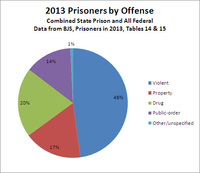
Prisoners2013.jpg
After the Republican Debate Wednesday night, numerous media outlets published "fact-check" stories regarding claims made during the debates.  So far I have not found a single "mainstream media" fact-check story that has questioned Carly Fiorina's whopper, "Two-thirds of the people in our prisons are there for non-violent offenses, mostly drug related."

As this pie chart illustrates (click on the graph for a larger view), that is not remotely close to the truth.  Why the silence?
  1 2 3 4 5 6 7 8 9 10 11 12 13 14 15 16 17 18 19 20 21 22 23 24 25 26 27 28 29 30 31 32 33 34 35 36 37 38 39 40 41 42 43 44 45 46 47 48 49 50 51 52 53 54 55 56 57 58 59 60 61 62 63 64 65 66 67 68 69 70 71 72 73 74 75 76 77 78 79 80 81 82 83 84 85 86 87 88 89 90 91 92 93 94 95 96 97 98 99  

Monthly Archives