Results matching “first”

Blog Scan

Expanding The Definition of "Crime Victims":  At Volokh Conspiracy, Paul Cassell has a post discussing his recently filed mandamus petition in the Eleventh Circuit.  The petition asks the court to recognize borrowers who were overcharged on loans as "crime victims" under the Crime Victims' Rights Act.  His petition challenges a ruling by a Florida District judge in November 2008, that borrowers on loans from Coast Bank were not "crime victims" of a criminal conspiracy because they were not specifically listed in the criminal charges against him.  It argues that because borrowers suffered financial losses from the fraud, they are "victims" entitled to the protections of the federal Crime Victim's Rights Act, and are entitled to restitution.  A copy of the petition can be found here.  Cassell seems particularly excited about the precedent this case could set.  He writes that this case "could produce the first appellate court decision deciding who is a 'victim' under the [Crime Victims' Rights Act]."  He hopes it will be "a nationally significant case that will set the precedent for whether people who harmed by financial crimes have rights in the process."  Doug Berman at Sentencing Law and Policy also has a post on Cassell's petition.

Another Take on Philip Morris Oral Arguments:  As a follow-up to Kent's post on today's Philip Morris arguments, here is a report from Jan Crawford Greenburg on the "60 minutes of non-stop action[,]" that occurred in the Court this morning.

Ohio State Journal of Criminal Law Tackles Sex Crimes:  At Sex Crimes, Corey Rayburn Young has this post  providing brief summaries of the three articles in the Journal's Fall 2008 issue.  Of particular interest is the article by Wayne A. Logan on "Criminal Justice Federalism and National Sex Offender Policy."  Rayburn's post provides a snippet from the article which discusses  the "nationalization of registration and notification, systematically achieved by the federal government over a fifteen-year period," and its "major effect on constitutional federalism and the states themselves."    

Call For Philip Morris

morris_small.jpg
The U. S. Supreme Court heard oral argument today in Philip Morris v. Williams. This is the third time this case has been to the high court. Lyle Denniston has this argument preview at SCOTUSblog. Debra Cassens Weiss has this story at ABA Journal Law News Now. CJLF's brief supporting neither party is here. Our interest in the case is in asking the Court to clean up its jurisprudence on the question of what is an "adequate" state ground for refusing to consider a federal question. The confusion in this area allows state prisoners to smuggle questions into federal habeas that they failed to raise in their state court appeals.

Mark Sherman of AP has this brief postargument story, and Lyle has this post suggesting that the Court might reconsider its earlier decision not to take up an underlying question on the merits of the case, different from the one the state court has now found procedurally barred.

Update: The transcript of the argument is available here. Notes on the argument with emphasis on the points that are particularly of interest to habeas practice follow the jump.

More Police, Less Crime

At a time when many municipalities are cutting services, comes this notable story by Gabriel Kahn from the Wall Street Journal:

"Shrinking budgets are forcing such cities as Phoenix, Portland, Ore., and San Diego to make deep cuts, including to police. But Los Angeles Police Chief William Bratton has grown his department with a persuasive argument about the financial costs of crime.


The city is adding 1,000 police officers, pushing its force levels in the Los Angeles Police Department to above 10,000 for the first time. Even as the city faces a more than $400 million shortfall for this fiscal year and next, the police budget -- the city's most costly department -- is emerging largely unscathed."

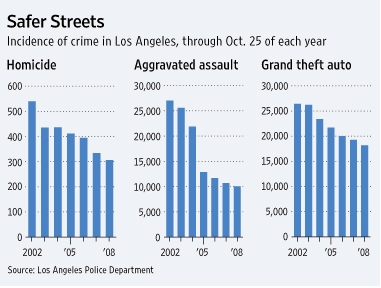
The article also notes the significant decline in crime in L.A. during the past six years which coincides with a sizable increase in the number of police officers.  While crime is surely a multifaceted problem, perhaps one of the answers is straightforward: more police results in less crime.  As Harvard law professor Bill Stuntz discusses, putting more "boots on the ground" likely is part of the answer to reducing crime in neighborhoods which are often seriously underpoliced.  The LA statistics seem to support this assertion. 

Interesting, Police Chief Bratton also argues that more police results in a fiscal savings for the city:

"Mr. Bratton said he thinks of Los Angeles's crime reduction as money in the bank. "The cost of a homicide to the city is $1 million," he said, citing an estimate based on a study by the National Institute of Justice that takes into account such costs as criminal trials and police salaries. 'We've reduced the homicide rate by nearly 300 in six years," he said. "That's a $300 million annual benefit to the city.'"    
 
Safer Streets.jpg
 

More Police, Less Crime

At a time when many municipalities are cutting services, comes this notable story by Gabriel Kahn from the Wall Street Journal:

"Shrinking budgets are forcing such cities as Phoenix, Portland, Ore., and San Diego to make deep cuts, including to police. But Los Angeles Police Chief William Bratton has grown his department with a persuasive argument about the financial costs of crime.


The city is adding 1,000 police officers, pushing its force levels in the Los Angeles Police Department to above 10,000 for the first time. Even as the city faces a more than $400 million shortfall for this fiscal year and next, the police budget -- the city's most costly department -- is emerging largely unscathed."

The article also notes the significant decline in crime in L.A. during the past six years which coincides with a sizable increase in the number of police officers.  While crime is surely a multifaceted problem, perhaps one of the answers is straightforward: more police results in less crime.  As Harvard law professor Bill Stuntz discusses, putting more "boots on the ground" likely is part of the answer to reducing crime in neighborhoods which are often seriously underpoliced.  The LA statistics seem to support this assertion. 

Interesting, Police Chief Bratton also argues that more police results in a fiscal savings for the city:

"Mr. Bratton said he thinks of Los Angeles's crime reduction as money in the bank. "The cost of a homicide to the city is $1 million," he said, citing an estimate based on a study by the National Institute of Justice that takes into account such costs as criminal trials and police salaries. 'We've reduced the homicide rate by nearly 300 in six years," he said. "That's a $300 million annual benefit to the city.'"    
 
Safer Streets.jpg
 

As reported in today's News Scan, the California Supreme Court has handed down its decision in People v. Brendlin. Yesterday's decision adopted a rule "that discovery of an outstanding arrest warrant prior to a search incident to arrest constitutes an intervening circumstance that may - and, in the absence of purposeful or flagrant police misconduct, will - attenuate the taint of the antecedent unlawful traffic stop." In other words, the drug paraphernalia found on Brendlin should be admitted as evidence even though the warrant for his arrest would not have been discovered "[b]ut for the unlawful vehicle stop." The lesson: if you have violated parole, and have a warrant out for your arrest, don't drive around in a car with containers that are used to make methamphetamine.
This was not the first time the California Supreme Court had heard Brendlin's case. In 2006, the court held that a passenger in a vehicle subject to a traffic stop is not seized within the meaning of the Fourth Amendment unless the passenger can show he was the subject of the officer's investigation and did not feel free to leave. The U.S. Supreme Court rejected this holding last April.

As reported in today's News Scan, the California Supreme Court has handed down its decision in People v. Brendlin. Yesterday's decision adopted a rule "that discovery of an outstanding arrest warrant prior to a search incident to arrest constitutes an intervening circumstance that may - and, in the absence of purposeful or flagrant police misconduct, will - attenuate the taint of the antecedent unlawful traffic stop." In other words, the drug paraphernalia found on Brendlin should be admitted as evidence even though the warrant for his arrest would not have been discovered "[b]ut for the unlawful vehicle stop." The lesson: if you have violated parole, and have a warrant out for your arrest, don't drive around in a car with containers that are used to make methamphetamine.
This was not the first time the California Supreme Court had heard Brendlin's case. In 2006, the court held that a passenger in a vehicle subject to a traffic stop is not seized within the meaning of the Fourth Amendment unless the passenger can show he was the subject of the officer's investigation and did not feel free to leave. The U.S. Supreme Court rejected this holding last April.

News Scan

CA Court Voids Execution Procedures: As posted by Kent Scheidegger, California's first district court of appeals ruled Friday, that the state's lethal injection procedures are invalid because the were not adopted through an administrative process which requires public comment and review by an independent state agency. A Los Angeles Times story by Carol Williams reports that a three judge panel of the San Francisco court unanimously affirmed a year-old ruling by Marin County Judge Lynne O'Malley Taylor. The challenge was brought by Michael Morales and Mitchell Sims. Morales was sentenced to die for attacking 17-year-old Terry Lynn Winchell with a hammer, strangling her with a belt and raping her before fatally stabbing her four times in the chest. Morales attorney, Brad Phillips, told the Times, "Our preferred alternative is to see the death penalty eliminated." To date, Attorney General Jerry Brown has not decided if he will appeal the ruling.

Early Test for Obama: The Supreme Court is expected to consider the case of a suspected al-Qaida sleeper agent Ali al-Marri on Tuesday, in what could be an early test regarding the handling of terrorists for the new administration according to this AP story by Mark Sherman and Meg Kinnard. Al-Marri, who is a legal resident in the U.S., is seeking review of his challenge to the Bush Administration's authority to detain him indefinitely him without charges or trial. If the Court agrees to hear al-Marri's case it will be argued next year. Brad Berenson, a former Bush Administration lawyer and Harvard classmate of the President-elect, said "Al-Marri is one of those cases where the rhetorical necessities of the campaign are likely to collide with the security necessities of governing."

News Scan

CA Court Voids Execution Procedures: As posted by Kent Scheidegger, California's first district court of appeals ruled Friday, that the state's lethal injection procedures are invalid because the were not adopted through an administrative process which requires public comment and review by an independent state agency. A Los Angeles Times story by Carol Williams reports that a three judge panel of the San Francisco court unanimously affirmed a year-old ruling by Marin County Judge Lynne O'Malley Taylor. The challenge was brought by Michael Morales and Mitchell Sims. Morales was sentenced to die for attacking 17-year-old Terry Lynn Winchell with a hammer, strangling her with a belt and raping her before fatally stabbing her four times in the chest. Morales attorney, Brad Phillips, told the Times, "Our preferred alternative is to see the death penalty eliminated." To date, Attorney General Jerry Brown has not decided if he will appeal the ruling.

Early Test for Obama: The Supreme Court is expected to consider the case of a suspected al-Qaida sleeper agent Ali al-Marri on Tuesday, in what could be an early test regarding the handling of terrorists for the new administration according to this AP story by Mark Sherman and Meg Kinnard. Al-Marri, who is a legal resident in the U.S., is seeking review of his challenge to the Bush Administration's authority to detain him indefinitely him without charges or trial. If the Court agrees to hear al-Marri's case it will be argued next year. Brad Berenson, a former Bush Administration lawyer and Harvard classmate of the President-elect, said "Al-Marri is one of those cases where the rhetorical necessities of the campaign are likely to collide with the security necessities of governing."

California Lethal Injection Decision

The California Court of Appeal, First District has held that the lethal injection protocol is a regulation subject to the Administrative Procedures Act. The decision in Morales v. Cal. Dept. of Corrections and Rehabilitation is here. If CDCR had simply checked the boxes on the APA when this first came up, the regulation would be final by now.

California Lethal Injection Decision

The California Court of Appeal, First District has held that the lethal injection protocol is a regulation subject to the Administrative Procedures Act. The decision in Morales v. Cal. Dept. of Corrections and Rehabilitation is here. If CDCR had simply checked the boxes on the APA when this first came up, the regulation would be final by now.

News Scan

Kentucky to Execute Chapman Tonight: Marco Allen Chapman, the confessed child killer who has sought execution since his conviction four years ago, is scheduled to be put to death tonight. A story by Courier-Journal writers Jason Riley and Deborah Yetter reports that Chapman's execution would be the first in Kentucky since 1999. In 2002, Chapman sexually assaulted Carolyn Marksberry and slashed the throats of her daughter Chelbi, 7, and son Cody, 6. Both Chelbi and Cody were killed while Carolyn's eldest daughter, Courtney, 10, was cut only in the face and survived the incident by playing dead.

Another Texas Killer Put to Death: Texas executed its 18th murderer yesterday as reported by AP writer Michael Graczyk. Robert Hudson received the death sentence for the 1999 murder of his ex-girlfriend, 35-year-old Edith Kendrick. The victim died from six to eight stab wounds, including three to her heart. During the attack, Kendrick's eight-year-old son was slashed in the throat while trying to protect her. The boy survived. Prior to the murder, Hudson had been convicted at least eight times for other crimes, including a 1987 Dallas murder.

Appeals Court Strikes Down Residency Restriction: California's Fourth District Court of Appeal has unanimously ruled that the provision of Proposition 83 (Jessica's Law) that prohibits registered sex offenders, sentenced before the law was passed, from living within 2,000 feet of schools or parks amounts to additional punishment. A story by SF Chronicle writer Bob Egelko reports that the decision is focused on defendants convicted and sentenced before the measure was was adopted in 2006, who have since been released on parole. For more commentary check out today's Blog Scan.

News Scan

Kentucky to Execute Chapman Tonight: Marco Allen Chapman, the confessed child killer who has sought execution since his conviction four years ago, is scheduled to be put to death tonight. A story by Courier-Journal writers Jason Riley and Deborah Yetter reports that Chapman's execution would be the first in Kentucky since 1999. In 2002, Chapman sexually assaulted Carolyn Marksberry and slashed the throats of her daughter Chelbi, 7, and son Cody, 6. Both Chelbi and Cody were killed while Carolyn's eldest daughter, Courtney, 10, was cut only in the face and survived the incident by playing dead.

Another Texas Killer Put to Death: Texas executed its 18th murderer yesterday as reported by AP writer Michael Graczyk. Robert Hudson received the death sentence for the 1999 murder of his ex-girlfriend, 35-year-old Edith Kendrick. The victim died from six to eight stab wounds, including three to her heart. During the attack, Kendrick's eight-year-old son was slashed in the throat while trying to protect her. The boy survived. Prior to the murder, Hudson had been convicted at least eight times for other crimes, including a 1987 Dallas murder.

Appeals Court Strikes Down Residency Restriction: California's Fourth District Court of Appeal has unanimously ruled that the provision of Proposition 83 (Jessica's Law) that prohibits registered sex offenders, sentenced before the law was passed, from living within 2,000 feet of schools or parks amounts to additional punishment. A story by SF Chronicle writer Bob Egelko reports that the decision is focused on defendants convicted and sentenced before the measure was was adopted in 2006, who have since been released on parole. For more commentary check out today's Blog Scan.

Blog Scan

Five Detainees Ordered Released: As reported yesterday on SCOTUSblog, and today in the New York Times and the Wall Street Journal , U.S. District Judge Richard J. Leon ordered the release of five Algerian Guantanamo detainees while ordering the continued detention of a sixth. The 14-page ruling can be found here. Judge Leon's ruling is the first decision addressing the Justice Department's justification for holding specific detainees. One of the detainees ordered released was Lakhdar Boumediene, the same Boumediene who was named in last term's Boumediene v. Bush. Lyle Denniston also reports on SCOTUSblog that "in an unusual added comment" Judge Leon suggested that the Justice Department forgo appeal of the five prisoners and allow them to return to Bosnia where they were captured. The Justice Department has not yet announced whether it will appeal.

Mukasey on U.S. Treatment of Detainees: It was almost as if the Wall Street Journal knew Attorney General Michael Mukasey would be making headlines this morning when it decided to run his Op-ed in today's edition. According to this post by Jonathan Adler at the Volokh Conspiracy, Mukasey's Op-ed addresses issues that are similar to those he addressed in last night's speech at the Federalist Society's Annual Lawyers' Convention. The Op-ed addresses yesterday's detainee decision and urges Congress to work with the current and new administration to establish a uniform framework for detainee cases. Mukasey believes three things: "First, Congress must make clear that release from the Guantanamo Bay military base does not mean that a detainee is entitled to enter the United States;" "Second, habeas corpus proceedings must protect the integrity of classified information and prevent disclosing that information to our enemies;" and "Third, Congress should establish sensible and uniform procedures that will eliminate the risk of duplicative efforts and inconsistent rulings, and strike a reasonable balance between the detainees' right to a hearing and our national security needs."

California Court Finds Sex Offender Restrictions to Be Punishment: At Sentencing Law and Policy, Doug Berman posted yesterday on a decision from a California Court of Appeal that "found that the residency restrictions in California's sex offender registration law are 'punishment' for Apprendi purposes." The decision, from the Fourth District of California the Court of Appeal, found an Apprendi violation because the judge "subjected defendant to the residency restriction by requiring sex offender registration based on its own fact-finding" when the jury had acquitted him of any sexual offense. The judge may not have been out of line, however, as the jury did convict the defendant of misdemeanor assault of a 12 year-old girl. The decision can be found here.

Blog Scan

Five Detainees Ordered Released: As reported yesterday on SCOTUSblog, and today in the New York Times and the Wall Street Journal , U.S. District Judge Richard J. Leon ordered the release of five Algerian Guantanamo detainees while ordering the continued detention of a sixth. The 14-page ruling can be found here. Judge Leon's ruling is the first decision addressing the Justice Department's justification for holding specific detainees. One of the detainees ordered released was Lakhdar Boumediene, the same Boumediene who was named in last term's Boumediene v. Bush. Lyle Denniston also reports on SCOTUSblog that "in an unusual added comment" Judge Leon suggested that the Justice Department forgo appeal of the five prisoners and allow them to return to Bosnia where they were captured. The Justice Department has not yet announced whether it will appeal.

Mukasey on U.S. Treatment of Detainees: It was almost as if the Wall Street Journal knew Attorney General Michael Mukasey would be making headlines this morning when it decided to run his Op-ed in today's edition. According to this post by Jonathan Adler at the Volokh Conspiracy, Mukasey's Op-ed addresses issues that are similar to those he addressed in last night's speech at the Federalist Society's Annual Lawyers' Convention. The Op-ed addresses yesterday's detainee decision and urges Congress to work with the current and new administration to establish a uniform framework for detainee cases. Mukasey believes three things: "First, Congress must make clear that release from the Guantanamo Bay military base does not mean that a detainee is entitled to enter the United States;" "Second, habeas corpus proceedings must protect the integrity of classified information and prevent disclosing that information to our enemies;" and "Third, Congress should establish sensible and uniform procedures that will eliminate the risk of duplicative efforts and inconsistent rulings, and strike a reasonable balance between the detainees' right to a hearing and our national security needs."

California Court Finds Sex Offender Restrictions to Be Punishment: At Sentencing Law and Policy, Doug Berman posted yesterday on a decision from a California Court of Appeal that "found that the residency restrictions in California's sex offender registration law are 'punishment' for Apprendi purposes." The decision, from the Fourth District of California the Court of Appeal, found an Apprendi violation because the judge "subjected defendant to the residency restriction by requiring sex offender registration based on its own fact-finding" when the jury had acquitted him of any sexual offense. The judge may not have been out of line, however, as the jury did convict the defendant of misdemeanor assault of a 12 year-old girl. The decision can be found here.

Blog Scan

Tomorrow is a Big Day for the Detainees: At Scotusblog, Lyle Denniston provides a "primer" detailing detainee cases that federal courts will hear tomorrow, and next week. He also comments on the significance of each of the cases. Beginning at 9:30 am a three-judge panel of the D.C. Circuit will hold a hearing in Bismullah, et al., v. Gates, to determine whether the D.C. Circuit has lost the authority to decide detainees’ challenges under the Detainee Treatment Act of 2005. The DTA had wiped out the courts' authority to decide these challenges, but, Boumediene v. Bush found the current DTA to be inadequate. With the DTA process still intact under the ruling, the Justice Department is arguing Boumediene left open only one avenue of review for detainees - habeas. Next up, U.S. District Judge Richard J. Leon is expected to issue his first ruling. He is expected to orally announce whether, with respect to six of the detainees, "the government, using both public and secret information, justified continued confinement of those captives? If not, what remedy will the judge impose?"

California Supreme Court Agrees to Decide the Constitutionality of Prop. 8: At Volokh Conspiracy, Eugene Volokh comments on this AP article about the high court's decision to hear three challenges to the constitutionality of Prop. 8. The petitioners in each of the cases have claimed Prop. 8 abridges the civil rights of a vulnerable minority group. Each argues "that voters alone did not have the authority to enact such a significant constitutional change...." Volokh is optimistic about the Court's resolution of the issue. He states it is "important to know what the law is on this, especially given the likelihood that Prop. 8 invalidates same-sex marriages that had been entered into after the earlier court decision but before Prop. 8's enactment." He also believes the court will hold that Prop. 8 was a valid amendment which "amends the state constitution in a way that supersedes the court's interpretation of the preexisting constitutional provisions."

North Carolina's Death Penalty: Hat tip to Doug Berman at Sentencing Law and Policy for providing a link to a Charlotte Observer article by Dan Kane that details yesterday's oral arguments over North Carolina's death penalty. Apparently, the North Carolina justices chided doctors and legislators for not resolving the lethal injection deadlock sooner. Earlier posts and news articles reported that North Carolina has effectively endured a two-year stalemate on executions.

Blog Scan

Tomorrow is a Big Day for the Detainees: At Scotusblog, Lyle Denniston provides a "primer" detailing detainee cases that federal courts will hear tomorrow, and next week. He also comments on the significance of each of the cases. Beginning at 9:30 am a three-judge panel of the D.C. Circuit will hold a hearing in Bismullah, et al., v. Gates, to determine whether the D.C. Circuit has lost the authority to decide detainees’ challenges under the Detainee Treatment Act of 2005. The DTA had wiped out the courts' authority to decide these challenges, but, Boumediene v. Bush found the current DTA to be inadequate. With the DTA process still intact under the ruling, the Justice Department is arguing Boumediene left open only one avenue of review for detainees - habeas. Next up, U.S. District Judge Richard J. Leon is expected to issue his first ruling. He is expected to orally announce whether, with respect to six of the detainees, "the government, using both public and secret information, justified continued confinement of those captives? If not, what remedy will the judge impose?"

California Supreme Court Agrees to Decide the Constitutionality of Prop. 8: At Volokh Conspiracy, Eugene Volokh comments on this AP article about the high court's decision to hear three challenges to the constitutionality of Prop. 8. The petitioners in each of the cases have claimed Prop. 8 abridges the civil rights of a vulnerable minority group. Each argues "that voters alone did not have the authority to enact such a significant constitutional change...." Volokh is optimistic about the Court's resolution of the issue. He states it is "important to know what the law is on this, especially given the likelihood that Prop. 8 invalidates same-sex marriages that had been entered into after the earlier court decision but before Prop. 8's enactment." He also believes the court will hold that Prop. 8 was a valid amendment which "amends the state constitution in a way that supersedes the court's interpretation of the preexisting constitutional provisions."

North Carolina's Death Penalty: Hat tip to Doug Berman at Sentencing Law and Policy for providing a link to a Charlotte Observer article by Dan Kane that details yesterday's oral arguments over North Carolina's death penalty. Apparently, the North Carolina justices chided doctors and legislators for not resolving the lethal injection deadlock sooner. Earlier posts and news articles reported that North Carolina has effectively endured a two-year stalemate on executions.

News Scan

East Bay Murderer Gets Death Penalty: Paul T. Rosynsky reported in the Mercury News that former Navy sailor Anthony McKnight smiled and openly laughed as he was sentenced to death for killing and raping five women in 1985 by an Alameda County Superior Court judge. McKnight's rampage began in October 1985 and ended four months later when the body of Beverly Bryant, 24, was found brutally beaten and raped in the courtyard of Howard Elementary School in Oakland. McKnight, was serving a 63-year prison sentence for assaulting six women from 1984 though 1986, will now be transported to the state's Death Row.

Ohio Murderer Executed: Gregory Bryant-Bey was executed today after the U.S. Supreme Court denied his request for a 60-day reprieve as reported by AP writer Andrew Welsh-Huggins. He died by lethal injection at 10:41 a.m. EST at the Southern Ohio Correctional Facility in Lucasville. Bryant-Bey was the second inmate put to death in Ohio since the end of last year's unofficial national moratorium on executions. He was convicted of the 1992 stabbing death of a collectibles store owner in Toledo. A previous post on the case is here.

A MetroCard Saves Murder Suspect: A story from the NY Times by Benjamin Weiser reports that a man named Jason Jones was arrested for a fatal shooting in the Bronx in May but was able to use his MetroCard to show that he was nowhere near the crime scene. The card showed that it had been used on a bus, and later on a subway roughly five miles from the shooting. Weiser reports that in an era before plastic MetroCards, which track and store data on where and when the cards are used in a central computer system, this type of investigation would not have been possible. In at least one instance, MetroCard's "electronic evidence" resulted in a conviction. Federal prosecutors also charged Jones' older brother, Corey, in the shooting. Both brothers have been released on bond for now, an unusual step in a federal murder case, while prosecutors continue to investigate.

Obama Expected To Appoint A Woman To The Supreme Court: An article by LA Times reporter David Savage predicts that a shift to the left on the Supreme Court is unlikely since none of the conservative justices are expected to retire in the next four years. While President Elect Obama has called former Justices Warren, Brennan and Marshall his heroes, many expect his first appointment to be a woman since there is currently only one woman on the Supreme Court. Some of the candidates include Judges Diane Wood Seventh Circuit Court of Appeals; Sonia Sotomayor of the Second Circuit; and Elena Kagan dean of Harvard Law School. The story suggests that Obama's background as a law professor, makes it unlikely that he will rely heavily on advisors to select his appointments for the high court.

News Scan

East Bay Murderer Gets Death Penalty: Paul T. Rosynsky reported in the Mercury News that former Navy sailor Anthony McKnight smiled and openly laughed as he was sentenced to death for killing and raping five women in 1985 by an Alameda County Superior Court judge. McKnight's rampage began in October 1985 and ended four months later when the body of Beverly Bryant, 24, was found brutally beaten and raped in the courtyard of Howard Elementary School in Oakland. McKnight, was serving a 63-year prison sentence for assaulting six women from 1984 though 1986, will now be transported to the state's Death Row.

Ohio Murderer Executed: Gregory Bryant-Bey was executed today after the U.S. Supreme Court denied his request for a 60-day reprieve as reported by AP writer Andrew Welsh-Huggins. He died by lethal injection at 10:41 a.m. EST at the Southern Ohio Correctional Facility in Lucasville. Bryant-Bey was the second inmate put to death in Ohio since the end of last year's unofficial national moratorium on executions. He was convicted of the 1992 stabbing death of a collectibles store owner in Toledo. A previous post on the case is here.

A MetroCard Saves Murder Suspect: A story from the NY Times by Benjamin Weiser reports that a man named Jason Jones was arrested for a fatal shooting in the Bronx in May but was able to use his MetroCard to show that he was nowhere near the crime scene. The card showed that it had been used on a bus, and later on a subway roughly five miles from the shooting. Weiser reports that in an era before plastic MetroCards, which track and store data on where and when the cards are used in a central computer system, this type of investigation would not have been possible. In at least one instance, MetroCard's "electronic evidence" resulted in a conviction. Federal prosecutors also charged Jones' older brother, Corey, in the shooting. Both brothers have been released on bond for now, an unusual step in a federal murder case, while prosecutors continue to investigate.

Obama Expected To Appoint A Woman To The Supreme Court: An article by LA Times reporter David Savage predicts that a shift to the left on the Supreme Court is unlikely since none of the conservative justices are expected to retire in the next four years. While President Elect Obama has called former Justices Warren, Brennan and Marshall his heroes, many expect his first appointment to be a woman since there is currently only one woman on the Supreme Court. Some of the candidates include Judges Diane Wood Seventh Circuit Court of Appeals; Sonia Sotomayor of the Second Circuit; and Elena Kagan dean of Harvard Law School. The story suggests that Obama's background as a law professor, makes it unlikely that he will rely heavily on advisors to select his appointments for the high court.

News Scan

Ayers Talks Death Penalty: Anti-war activist William Ayers, and former member of the Weather Underground, emphasized his opposition to the death penalty in a speech at the Georgetown University Law Center last night reports Gregg Re from The Hoya. Recently, Ayers has attracted national attention during the presidential campaign for his past association to President-elect Barack Obama. During his speech Ayers specifically condemned the atmosphere at the execution of serial killer John Gacy in 1994 and said that the death penalty evokes disturbing emotions and occasionally punishes the innocent. Ayers also challenged claims that he is a terrorist, criticizing the Vietnam War and the current war in Iraq as terrorist acts. Some students and alumni in attendance questioned the Law Center’s invitation to Ayers, arguing that the Law Center should not condone violent radicalism.

Court Stays Execution of Texas Murderer: An AP story by Michael Graczyk reports that the Texas Court of Criminal Appeals has stayed the execution of Houston killer Eric Dewayne Cathey. Cathey was convicted of the abduction and murder of a 20-year-old woman in Houston more than 13 years ago. Appeals were filed late in the day on Monday, arguing Cathey was mentally retarded and ineligible for execution under U.S. Supreme Court rulings.

Court May Break NC Stalemate On Executions: According to an article by Dan Kane from the Charlotte Observer, North Carolina's highest court will hear legal arguments today that could break the two-year stalemate on executions or extend the de facto moratorium. State law requires that a doctor be present during executions, but, the NC Medical Board prohibited doctors from taking part. The board contends such participation violates the profession's mission to preserve life. This all began last March when North Carolina's Department of Correction filed suit after doctors said they could not risk their licenses by participating in executions. A state Superior Court Judge sided with correction officials, and prompted medical board to appeal. If the North Carolina Supreme Court rules that the medical board cannot bar doctors from taking part in executions, lawyers representing death row inmates plan to claim the state's execution process is invalid because public hearings were not held prior to its adoption.

Killer Of 3-Year-Old Escapes Death Penalty: Jim Walsh from The Arizona Republic reports that Christopher Langin escaped the death penalty Monday for the shocking 2005 murder of his best friend's 3-year-old daughter. The jury gave Langin life in prison. One of Langin's defense attorneys, Joey Hamby, said jurors told him the first vote was 7-5 for death but eventually shifted to a unanimous verdict for life in prison. Langin was found guilty of felony murder committed during the crime of child abuse.

News Scan

Ayers Talks Death Penalty: Anti-war activist William Ayers, and former member of the Weather Underground, emphasized his opposition to the death penalty in a speech at the Georgetown University Law Center last night reports Gregg Re from The Hoya. Recently, Ayers has attracted national attention during the presidential campaign for his past association to President-elect Barack Obama. During his speech Ayers specifically condemned the atmosphere at the execution of serial killer John Gacy in 1994 and said that the death penalty evokes disturbing emotions and occasionally punishes the innocent. Ayers also challenged claims that he is a terrorist, criticizing the Vietnam War and the current war in Iraq as terrorist acts. Some students and alumni in attendance questioned the Law Center’s invitation to Ayers, arguing that the Law Center should not condone violent radicalism.

Court Stays Execution of Texas Murderer: An AP story by Michael Graczyk reports that the Texas Court of Criminal Appeals has stayed the execution of Houston killer Eric Dewayne Cathey. Cathey was convicted of the abduction and murder of a 20-year-old woman in Houston more than 13 years ago. Appeals were filed late in the day on Monday, arguing Cathey was mentally retarded and ineligible for execution under U.S. Supreme Court rulings.

Court May Break NC Stalemate On Executions: According to an article by Dan Kane from the Charlotte Observer, North Carolina's highest court will hear legal arguments today that could break the two-year stalemate on executions or extend the de facto moratorium. State law requires that a doctor be present during executions, but, the NC Medical Board prohibited doctors from taking part. The board contends such participation violates the profession's mission to preserve life. This all began last March when North Carolina's Department of Correction filed suit after doctors said they could not risk their licenses by participating in executions. A state Superior Court Judge sided with correction officials, and prompted medical board to appeal. If the North Carolina Supreme Court rules that the medical board cannot bar doctors from taking part in executions, lawyers representing death row inmates plan to claim the state's execution process is invalid because public hearings were not held prior to its adoption.

Killer Of 3-Year-Old Escapes Death Penalty: Jim Walsh from The Arizona Republic reports that Christopher Langin escaped the death penalty Monday for the shocking 2005 murder of his best friend's 3-year-old daughter. The jury gave Langin life in prison. One of Langin's defense attorneys, Joey Hamby, said jurors told him the first vote was 7-5 for death but eventually shifted to a unanimous verdict for life in prison. Langin was found guilty of felony murder committed during the crime of child abuse.

News Scan

Iowa Sex Offender Cohabitant Law Upheld: An AP story by Michael Crumb reports that the Iowa Supreme Court, in a split opinion, upheld a law that bars single parents from living with convicted sex offenders. The case involves a Coralville woman found guilty of child endangerment and sentenced to one year probation because she lived with a convicted sex offender and let her children stay with the man - so long as they were supervised by her mother or her sister - while she was at work. In her appeal, Holly Mitchell argued that her equal protection rights were violated because the Iowa Legislature decided to distinguish between married and unmarried people, subjecting only unmarried people to criminal charges for engaging in the same behavior as married people.

Ohio Man Faces Execution Wednesday: A story from Chillicothe Gazette reports that a man whose arrest in one killing led to a death sentence for another killing will face execution Wednesday. Gregory Bryant-Bey has been on death row for 16 years, and is scheduled to die by lethal injection for the 1992 killing of Toledo collectibles store owner Dale Pinkelman. Pinkelman's murder went unsolved for more than three months. It was not until detectives noted similarities in the killing of Peter Mihas, owner of The Board Room restaurant in downtown Toledo, that they began to suspect Bryant-Bey in Pinkelman's murder. Bryant-Bey faced two death penalty trials for each killing. He was given a life sentence for Mihas' slaying and the death penalty for Pinkelman's killing.

Baby Killer Gets Baby Sentence: A Kentucky man originally charged with murder for beating his 8-month-old stepdaughter to death agreed to plead guilty to the lesser charges of manslaughter and criminal abuse, and will serve 10 years for the crimes. A story by writer Julia Hunter in the Kentucky New Era reports that Robert Curlee received his sentence last week for killing little Jillian Niles on October 10, 2004. At the time of the child's death Curlee was being investigated for child abuse after it was discovered that she had fractured ribs. Curlee's wife, Megan Niles-Curlee, was also charged with murder and first-degree criminal abuse. Last week, she pleaded guilty to lesser charge of endangering the welfare of a minor, a misdemeanor, on the criminal abuse charge. She was sentenced to one year of unsupervised probation.

News Scan

Iowa Sex Offender Cohabitant Law Upheld: An AP story by Michael Crumb reports that the Iowa Supreme Court, in a split opinion, upheld a law that bars single parents from living with convicted sex offenders. The case involves a Coralville woman found guilty of child endangerment and sentenced to one year probation because she lived with a convicted sex offender and let her children stay with the man - so long as they were supervised by her mother or her sister - while she was at work. In her appeal, Holly Mitchell argued that her equal protection rights were violated because the Iowa Legislature decided to distinguish between married and unmarried people, subjecting only unmarried people to criminal charges for engaging in the same behavior as married people.

Ohio Man Faces Execution Wednesday: A story from Chillicothe Gazette reports that a man whose arrest in one killing led to a death sentence for another killing will face execution Wednesday. Gregory Bryant-Bey has been on death row for 16 years, and is scheduled to die by lethal injection for the 1992 killing of Toledo collectibles store owner Dale Pinkelman. Pinkelman's murder went unsolved for more than three months. It was not until detectives noted similarities in the killing of Peter Mihas, owner of The Board Room restaurant in downtown Toledo, that they began to suspect Bryant-Bey in Pinkelman's murder. Bryant-Bey faced two death penalty trials for each killing. He was given a life sentence for Mihas' slaying and the death penalty for Pinkelman's killing.

Baby Killer Gets Baby Sentence: A Kentucky man originally charged with murder for beating his 8-month-old stepdaughter to death agreed to plead guilty to the lesser charges of manslaughter and criminal abuse, and will serve 10 years for the crimes. A story by writer Julia Hunter in the Kentucky New Era reports that Robert Curlee received his sentence last week for killing little Jillian Niles on October 10, 2004. At the time of the child's death Curlee was being investigated for child abuse after it was discovered that she had fractured ribs. Curlee's wife, Megan Niles-Curlee, was also charged with murder and first-degree criminal abuse. Last week, she pleaded guilty to lesser charge of endangering the welfare of a minor, a misdemeanor, on the criminal abuse charge. She was sentenced to one year of unsupervised probation.

Just Can't Help Themselves

John Seabrook of the New Yorker has this in-depth article about Dr. Kent Kiehl at the University of New Mexico titled Suffering Souls. As the article details, Dr. Kiehl is the leading expert in the field of brain imaging and psychopathy. As part of his work with the Mind Research Network, Dr. Kiehl is using a portable fMRI machine to image hundreds of prison inmates and juvenile delinquents. The work is impressive and illuminating, but prone to Overclaim Syndrome as is evident near the end of the article:

Psychopathy also raises fundamental issues about justice. At the core of our judicial system is the assumption that someone who appears sane is culpable for his actions. (In the U.S., there is no insanity defense for psychopaths.) As Decety, of the University of Chicago, put it to me, “We still basically work out of a Biblical system of punishment—we don’t consider, in most cases, to what extent the offender’s actions were intentional or unintentional. But what neuroscience is showing us is that a great many crimes are committed out of compulsion—the offenders couldn’t help it. Once that is clear, and science proves it, what will the justice system do?” Joseph Newman told me, “I go around and give speeches to the staff in prisons, saying the inmates are not just assholes, and afterwards the guards come up and say, ‘Enjoyed your talk, Doc, but are you saying these guys aren’t responsible for their crimes?’ ”

Besides the fact that mens rea is very much part of American criminal law, there exist at least two problems with this sort of conclusion. First, despite the weight of neuroscience showing abnormalities in the brains of psychopaths, the theory that psychopaths have uncontrollable impulses remains unproven. This is no small matter as controllable impulses are writ large in human nature. Second, what matters for the law is not whether the brain is compromised but whether such impairments are so substantial that they deprive one of the ability to know their behavior was wrongful at the time of the alleged crime. Predisposition for behavior - which is what the hard line biological psychopathy crowd is asserting - is not sufficient to reduce culpability - and for good reason. We are all predisposed genetically towards behaviors. And some people, unfortunately, suffer worse biological deficits than others. But legal culpability is grounded in a social heritage which sets the exculpating bar high under the assumption that everyone brings liabilities to the responsibility table. Our society has determined that outside severe deficits in rationality, one is expected to conform their behavior according to the law irrespective of their biological imperfections.

Hat tip: Furious Seasons

Just Can't Help Themselves

John Seabrook of the New Yorker has this in-depth article about Dr. Kent Kiehl at the University of New Mexico titled Suffering Souls. As the article details, Dr. Kiehl is the leading expert in the field of brain imaging and psychopathy. As part of his work with the Mind Research Network, Dr. Kiehl is using a portable fMRI machine to image hundreds of prison inmates and juvenile delinquents. The work is impressive and illuminating, but prone to Overclaim Syndrome as is evident near the end of the article:

Psychopathy also raises fundamental issues about justice. At the core of our judicial system is the assumption that someone who appears sane is culpable for his actions. (In the U.S., there is no insanity defense for psychopaths.) As Decety, of the University of Chicago, put it to me, “We still basically work out of a Biblical system of punishment—we don’t consider, in most cases, to what extent the offender’s actions were intentional or unintentional. But what neuroscience is showing us is that a great many crimes are committed out of compulsion—the offenders couldn’t help it. Once that is clear, and science proves it, what will the justice system do?” Joseph Newman told me, “I go around and give speeches to the staff in prisons, saying the inmates are not just assholes, and afterwards the guards come up and say, ‘Enjoyed your talk, Doc, but are you saying these guys aren’t responsible for their crimes?’ ”

Besides the fact that mens rea is very much part of American criminal law, there exist at least two problems with this sort of conclusion. First, despite the weight of neuroscience showing abnormalities in the brains of psychopaths, the theory that psychopaths have uncontrollable impulses remains unproven. This is no small matter as controllable impulses are writ large in human nature. Second, what matters for the law is not whether the brain is compromised but whether such impairments are so substantial that they deprive one of the ability to know their behavior was wrongful at the time of the alleged crime. Predisposition for behavior - which is what the hard line biological psychopathy crowd is asserting - is not sufficient to reduce culpability - and for good reason. We are all predisposed genetically towards behaviors. And some people, unfortunately, suffer worse biological deficits than others. But legal culpability is grounded in a social heritage which sets the exculpating bar high under the assumption that everyone brings liabilities to the responsibility table. Our society has determined that outside severe deficits in rationality, one is expected to conform their behavior according to the law irrespective of their biological imperfections.

Hat tip: Furious Seasons

News Scan

Texas Executes 17th Murderer: A New York parolee was executed in Texas Thursday as reported by the Associate Press. Denard Manns, who had an extensive criminal record, was convicted and sentenced to die for the 1998 robbery, rape and murder of 26-year-old Michelle Robson, an Army medic at Fort Hood.

Money & Judges: Should judges who gain their seats in contested elections recuse themselves in cases involving contributors to their campaigns? The Supreme Court has taken the case of Caperton v. A.T. Massey Coal Company, Inc., et al. to make that determination. An Associate Press story by Mark Sherman reports that the case involves a member of the West Virginia Supreme Court who ruled in favor of $3 million contributor to his election.

Death Penalty a Bargaining Tool: A Utah man facing changes of capital murder has plead guilty in order to avoid the death penalty. A story by Stephen Hunt in the Salt Lake Tribune reports that Donald Bret Richardson agreed the plea rather than face trial for first strangling his ex-girlfriend to death and then shooting a former friend an hour later. Richardson admitted to the killings last April shortly after his arrest. According to the story, he originally wanted to be executed but eventually agreed to the plea bargain to avoid putting his family through a lengthy capital trial.

News Scan

Texas Executes 17th Murderer: A New York parolee was executed in Texas Thursday as reported by the Associate Press. Denard Manns, who had an extensive criminal record, was convicted and sentenced to die for the 1998 robbery, rape and murder of 26-year-old Michelle Robson, an Army medic at Fort Hood.

Money & Judges: Should judges who gain their seats in contested elections recuse themselves in cases involving contributors to their campaigns? The Supreme Court has taken the case of Caperton v. A.T. Massey Coal Company, Inc., et al. to make that determination. An Associate Press story by Mark Sherman reports that the case involves a member of the West Virginia Supreme Court who ruled in favor of $3 million contributor to his election.

Death Penalty a Bargaining Tool: A Utah man facing changes of capital murder has plead guilty in order to avoid the death penalty. A story by Stephen Hunt in the Salt Lake Tribune reports that Donald Bret Richardson agreed the plea rather than face trial for first strangling his ex-girlfriend to death and then shooting a former friend an hour later. Richardson admitted to the killings last April shortly after his arrest. According to the story, he originally wanted to be executed but eventually agreed to the plea bargain to avoid putting his family through a lengthy capital trial.

News Scan

First-Year Law Student Fights Intruder For His Laptop: A story from KTAR news reports that a student from Arizona State University, wrestled and fought with an intruder who demanded his laptop. Police said Gabriel Saucedo entered Alex Botsios' apartment through an open window early Thursday morning. When Botsios woke up, Saucedo threatened him with a baseball bat, police said. Botsios was willing to give up his wallet and guitars without a struggle, but not the laptop. Police took Saucedo to the hospital for stitches and then to jail. Botsios had no significant injuries. Happy to still have his laptop containing months of school work, he said he learned to not leave windows open.

NJ School Officals Can Now Search Student's Cars Without A Warrant: Education Writer Diane D'Amico reports that the New Jersey state appellate court ruled that school officials do not need a warrant to search a student's car if it is parked with special permission on school grounds and if they reasonably suspect evidence of illegal activity will be found in the vehicle. The court has said the privacy interests of the student are outweighed by the interest of administrators in maintaining a drug-free environment. In its decision, the appellate court also said that the U.S. Supreme Court has previously ruled that a school setting lessens the requirements traditionally applied to searches, which has allowed schools to search book bags and lockers.

Jury Considers Death Penalty For Courthouse Killer: An AP story reports that prosecutors are urging jurors to recommend the death sentence for Brian Nichols convicted of killing a judge and three others in an Atlanta courthouse shooting spree. Prosecutor Kellie Hill told jurors Wednesday that Nichols would try to escape again and kill if they sentenced him to life in prison. Nichols had pleaded not guilty by reason of insanity. However, the same jury last week convicted him of 54 counts including murder. Authorities say Nichols has already been plotting to break out of jail.

Change?: SF Chrontrarian Debra Saunders has this post-election comment on what will not change in Washington.

News Scan

First-Year Law Student Fights Intruder For His Laptop: A story from KTAR news reports that a student from Arizona State University, wrestled and fought with an intruder who demanded his laptop. Police said Gabriel Saucedo entered Alex Botsios' apartment through an open window early Thursday morning. When Botsios woke up, Saucedo threatened him with a baseball bat, police said. Botsios was willing to give up his wallet and guitars without a struggle, but not the laptop. Police took Saucedo to the hospital for stitches and then to jail. Botsios had no significant injuries. Happy to still have his laptop containing months of school work, he said he learned to not leave windows open.

NJ School Officals Can Now Search Student's Cars Without A Warrant: Education Writer Diane D'Amico reports that the New Jersey state appellate court ruled that school officials do not need a warrant to search a student's car if it is parked with special permission on school grounds and if they reasonably suspect evidence of illegal activity will be found in the vehicle. The court has said the privacy interests of the student are outweighed by the interest of administrators in maintaining a drug-free environment. In its decision, the appellate court also said that the U.S. Supreme Court has previously ruled that a school setting lessens the requirements traditionally applied to searches, which has allowed schools to search book bags and lockers.

Jury Considers Death Penalty For Courthouse Killer: An AP story reports that prosecutors are urging jurors to recommend the death sentence for Brian Nichols convicted of killing a judge and three others in an Atlanta courthouse shooting spree. Prosecutor Kellie Hill told jurors Wednesday that Nichols would try to escape again and kill if they sentenced him to life in prison. Nichols had pleaded not guilty by reason of insanity. However, the same jury last week convicted him of 54 counts including murder. Authorities say Nichols has already been plotting to break out of jail.

Change?: SF Chrontrarian Debra Saunders has this post-election comment on what will not change in Washington.

SCOTUS Today

The U.S. Supreme Court issued its first opinion of the term in an argued case, Winter v. Natural Resources Defense Council, Inc., No. 07-1239, the "boink the whales" case. SCOTUSblog has a report here.

On the argument calendar for today is Bell v. Kelly, which could be the "sleeper" case of the term. Both sides are "all-in" on the question of the interaction between new evidence in federal habeas hearings and the deference standard of 28 U.S.C. § 2254(d). Petitioner claims that (1) the question of whether the state court decision was "reasonable" for the purpose of 2254(d) must be determined solely on the state court record, and (2) if petitioner presents substantial new evidence in federal court in support of his claim, that makes it a new claim not subject to the deference standard.

Our side responds that he is right on (1) but wrong on (2). A "claim" is one legal ground for overturning the judgment. Ineffective assistance is one claim, no matter how many failings of the trial attorney are alleged. If the state court's rejection of that claim on the basis of the evidence state habeas counsel put before it was reasonable, the claim should be denied under 2254(d), and therefore there is no need for a hearing or discovery in federal court. CJLF's brief is here, and our press release is here.

Update: A post-argument note is here.

SCOTUS Today

The U.S. Supreme Court issued its first opinion of the term in an argued case, Winter v. Natural Resources Defense Council, Inc., No. 07-1239, the "boink the whales" case. SCOTUSblog has a report here.

On the argument calendar for today is Bell v. Kelly, which could be the "sleeper" case of the term. Both sides are "all-in" on the question of the interaction between new evidence in federal habeas hearings and the deference standard of 28 U.S.C. § 2254(d). Petitioner claims that (1) the question of whether the state court decision was "reasonable" for the purpose of 2254(d) must be determined solely on the state court record, and (2) if petitioner presents substantial new evidence in federal court in support of his claim, that makes it a new claim not subject to the deference standard.

Our side responds that he is right on (1) but wrong on (2). A "claim" is one legal ground for overturning the judgment. Ineffective assistance is one claim, no matter how many failings of the trial attorney are alleged. If the state court's rejection of that claim on the basis of the evidence state habeas counsel put before it was reasonable, the claim should be denied under 2254(d), and therefore there is no need for a hearing or discovery in federal court. CJLF's brief is here, and our press release is here.

Update: A post-argument note is here.

  1 2 3 4 5 6 7 8 9 10 11 12 13 14 15 16 17 18 19 20 21 22 23 24 25 26 27 28 29 30 31 32 33 34 35 36 37 38 39 40 41 42 43 44 45 46 47 48 49 50 51 52 53 54 55 56 57 58 59 60 61 62 63 64 65 66 67 68 69 70 71 72 73 74 75 76 77 78 79 80 81 82 83 84 85 86 87 88 89 90 91 92 93 94 95 96 97 98 99  

Monthly Archives