Recently in Studies Category

Violent_DPsupp.jpeg


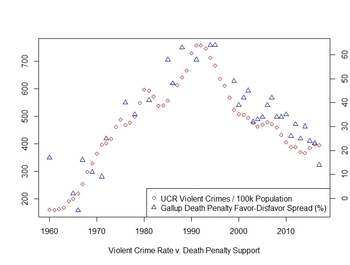
Those of us who believe that people who commit serious crimes against others should be fully punished for what they have done have had a more difficult time in the legislative arena than at any time since the 1960s.


Although it would be simplistic to attribute the change to any one cause, surely a major cause, probably the primary cause, is the drop in crime rates.

Crime Rate Lunacy

| No Comments
No, crime does not increase during a full moon, the BetaGov team at NYU's Marron Institute of Urban Management reports in this press release.
The FBI published its annual crime statistics, Crime in the United States 2018, today. The violent crime rate dropped 3.6%, not quite back to the 2014 low, but getting there. The property crime rate continued its steady decline, dropping 6.9%. "Rate," for both figures, means number of crimes per 100,000 population, as distinguished from the raw count of crimes.

Also continuing the trend, California did not fully share in the drop, as it has not since it began its mass decarceration project in 2011. The drops in California rates were 1.3% for violent and 5% for property.
The California Attorney General today released the annual report of state crime statistics, Crime in California, 2018. The violent crime index has returned to its 2016 level after a bump last year. Homicide is back to its 2014 level, tying the lowest rate since the 1960s.

Over the past four years, California's violent crime rates have risen more than the national rates, as described in this post last September and illustrated in this graph. We will have to wait a few months for the national report to see the comparison for 2018.
Sex offenders released from prison are three times as likely as other released offenders to be arrested for a new sex crime within nine years of release.

Sex offenders released from prison are less likely than other offenders to be arrested for a new crime within nine years of release.

Both of these statements are true, according to a study released today by the U.S. Bureau of Justice Statistics. See the spin potential?

I predict that this study will be exploited in numerous statistics crimes within a year of its release.
For several years now, I have been tracking the crime rates reported in the FBI's Preliminary Semiannual Uniform Crime Report. The 2016 post, with notes on the data, is here. The 2018 post is here. For an earlier look at regions, rather than states, see this post from 2014.

For the current report -- data for the first half of 2018 versus the first half of 2017 in cities over 100,000 population -- we once again see that California compares unfavorably with the rest of the country. This year, though, the year-to-year change is only worse in violent crimes, not property crimes.

How Common Are Wrongful Convictions?

| No Comments
How often does it happen in America that innocent people are convicted of crimes they did not commit? Is it really as common as the estimates we so often see cited, or is the real frequency different?

The Arizona Law Review has published new estimates by two authors giving different answers to this question: a lot lower and drastically lower.

Paul Cassell of the University of Utah gives us the "drastically lower" answer in the lead article. His estimate of the frequency of wrongful convictions is a range of 0.016% to 0.062%, in contrast to the commonly cited estimates ranging from 1% to 4%. George Thomas of Rutgers gives us the "a lot lower" answer in his "partial response" article, with a range of 0.125% to 0.5%. Prof. Cassell also has a reply article and a post at the Volokh Conspiracy.

We should not, of course, minimize the problem of wrongful convictions. A single one is a miscarriage of justice and devastating to the people involved. That is why, even as we limit repeated reviews of convictions on innocence-irrelevant grounds, we should maintain or widen avenues of review for cases of genuine "got the wrong guy" innocence. I insisted on that in the drafting of what became California's Proposition 66.

We also should not uncritically accept dubious estimates from notorious exaggerators. See Ward Campbell, Exoneration Inflation (2008). I welcome these new contributions to the field and look forward to reading them more closely.

Criminal Victimization, 2016: Revised

| 2 Comments
The Bureau of Justice Statistics has released a revision of its 2016 National Crime Victimization Survey results. Here are links to the press release and full report.

The NCVS is different from the FBI's Uniform Crime Reports, better in some ways and not as good in others. As a survey, it does not depend on crimes being reported to police, but it is subject to sampling error. Because respondents are only asked about crime committed against themselves, it does not measure homicides or crimes against children. The indexes are also put together somewhat differently.

The revision shows a smaller bump in the violent crime rate between 2015 and 2016, falling beneath the threshold of "statistical significance." (There's that troublesome sampling error.) The UCR shows a 3.4% increase for the same interval.

The revised NCVS does show a significant increase in violent crimes against males and persons aged 25-34. It's not immediately obvious why there would be a bump in that particular bracket.

Missing Data

| No Comments
The FBI's Uniform Crime Reports are the basis of a great deal of the research on crime. But there are problems, Jo Craven McGinty reports for the WSJ:

In any given year, more than 18,000 U.S. police agencies are asked to submit crime data to the FBI. But some don't provide complete information or, in some cases, any information at all.

When that happens, the Federal Bureau of Investigation uses crude estimates to account for the missing data. Those figures are then used to generate "Crime in the United States," an annual tally of violent and property crimes that is a quality-of-life measure as well as a gauge of criminal justice policies and spending.

*      *      *

Other experts believe, at minimum, the FBI should use a more sophisticated system for generating estimates.

Two decades ago,  the Bureau of Justice Statistics, a unit of the Justice Department, published a 78-page paper critiquing the FBI's procedure and recommending ways to improve it.

"So far, nothing has come of it," said Michael D. Maltz, the criminologist who wrote the paper and is now a researcher at Ohio State University's Criminal Justice Research Center.

A year and a half ago, I wrote a post comparing crime rates in California versus the country as a whole for the period 2011-2015. Because California has been the most vigorous state in dismantling its prior tough-on-crime policies, this seemed to be a useful comparison. The first post began with a year that was mostly before the effective date of the Realignment bill, changing the sentence for many junior-grade felonies from state prison to county jail, and it ended with the first year after Proposition 47, which changed many felonies to misdemeanors.

Since that post, we have had two years of official crime statistics published in the FBI's annual Crime in the United States reports, and I also went a few years further back to add more perspective.  Here are the results in graphic form (click on the graph for a larger version):
USvCalProperty08_17.gif
USvCalViolent08_17.gif

Problems With Comparing Rates

| No Comments
This article in the WSJ isn't directly related to criminal law, but it nicely illustrates a problem in social statistics that comes up all the time in policy discussions about crime.

The article is titled The Most Dangerous Place to Bicycle in America. How do they measure dangerousness? Their measure is a ratio with the number of people killed in bicycle accidents in a ten-year period in the numerator and the population divided by 100,000 in the denominator. That is, they define dangerousness = deaths / (pop/100000). See the problem?

Non-Reproduced Results

| No Comments
"A lot of what we think we know about human psychology is bunk," write Russell Warne and Jordan Wagge in the WSJ.

Reproducible experiments are the cornerstone of science.  It is not enough that someone has done an experiment and gotten a result.   Others need to reproduce the experiment and get the same result.  Remember "cold fusion"?  It was bunk, and the fact that other researchers could not reproduce it proved it was bunk.

What if a result is announced with great fanfare and nobody bothers to try to reproduce it?  That is why so much of what we think we know is bunk, according to Warne and Wagge.
Paul Mirengoff at Powerline has this post on the recent BJS recidivism study (discussed in this post) and its implications for the so-called "prison reform" legislation pending in Congress:

The results of the study should deter the Senate from embracing the FIRST STEP legislation passed by the House just before the BJS figures were published. Indeed, the BJS numbers undermine FIRST STEP in multiple ways.
I will have more to say on the bill later.  On a first read, though, it appears to have been written by people with a unicorns-and-rainbows view of prisoners and the value of "programs."

The Hard Truth About Recidivism

| 2 Comments
Rehabilitation is a beautiful thing.  The story of a person who previously followed a life of crime seeing the light, turning himself around, and becoming a productive and law-abiding member of society warms our hearts.

Regrettably, it is very much the exception, not the rule.  Most criminals released from prison go right back to their old ways.

Criminologists measure recidivism by a new arrest after release.  This measure is imperfect, to put it mildly, because arrest does not equal guilt.  Not all arrested are guilty, and not all guilty are arrested.  Given the low clearance rate for crimes (46% for violent and 18% for property in the 2016 CIUS), the latter problem is the bigger one by far.  That is, the real recidivism rate is much higher than the reported rate because the perpetrator does not get caught for most crimes.

The recidivism rate for a cohort of released criminals also depends on how many years you follow up.  If a researcher-advocate wants a low number, all he has to do is define recidivism for the purpose of the study with a short follow-up period.

Today the U.S. Bureau of Justice Statistics released a report titled 2018 Update on Prisoner Recidivism:  A 9-Year Follow-up Period (2005-2014).  The nine-year period is new, and the report confirms what we have known from shorter but varying periods: the longer you follow up, the greater percentage is eventually arrested for a new crime.  At nine years, the percentage not arrested at any time in the follow-up period down to a discouraging 16.6%, only 1 in 6.

Are the people arrested in year 9 but not in years 1--8 people who went straight for 8 years and then fell off the wagon?  Doubtful.  More likely they were just good at evading capture for 8 years but eventually slipped up.
Santa Monica Violent Crime Up 50%

| No Comments
Niki Cervantes reports for the Santa Monica Lookout:

Violent crime in Santa Monica jumped almost 50 percent in 2017 over the previous year, reaching its highest level in two decades, according to police and Federal Bureau of Investigation (FBI) statistics.

Data released by the City showed a total of 705 violent crimes in Santa Monica, or 230 more incidents than the 475 reported in 2016 -- a 48 percent increase.

Behind the big jump in violent crimes was a rocketing number of aggravated assaults, the City's data showed. Those crimes increased 67 percent, from 244 incidents in 2016 to 407 reported occurrences last year.

Last year also marked the third year in a row of increases in violent crime, which also includes robbery (up 28 percent from 2016, or 241 incidents), rape (up from 40 in 2016 to 57 in 2017) and homicide (one incident in 2016 and two in 2017).

*      *      *

As with law enforcement throughout California, Santa Monica police blame much the rise in crime on two statewide measures approved by voters over the past four years.

Monthly Archives