
Americans' direct experience with crime is at a 16-year high, consistent with a gradual increase -- from 22% in 2001 to 29% today -- in the percentage saying that they or a household member was the victim of a robbery, vandalism or violent crime in the past year.
In the same poll, Americans' perceptions of the seriousness of crime nationally and in their local area was unchanged from 2015. But longer term, it has worsened slightly since 2001. As a result, while crime was not at the top of the candidates' or voters' agenda in the 2016 presidential campaign, the issue may be ripe for policymakers at all levels of government to address.
What's the smart way for Congress to address the problem of rising crime? By decreasing the cost of committing crime, as sentencing reformers would have it?
The question answers itself.
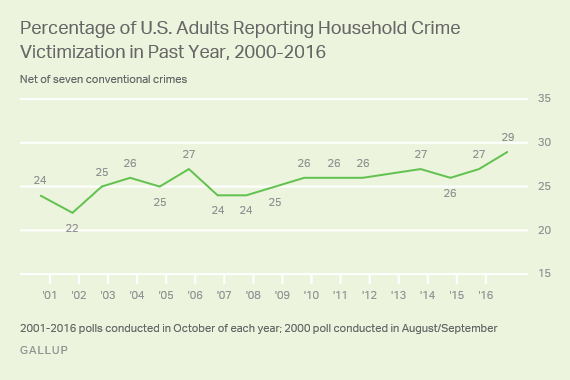


Interesting chart, Bill, but my eyes suggest # is 27% for 2016. Where do you get the number 29% for Obama's last year?
Also, Bill, how do you think we can best explain big drop from 27% to 24% from 2006 to 2007-08? The most notable federal sentencing developments in 2007 were the first big reduction in the crack guideline and the Gall and Kimbrough rulings.
Relatedly, aren't total murders now, though up in 2015 and so far in 2016, sill lower than in 2008 when Obama was elected?
I now clicked through to the full article to see where the 29% number comes from. I also saw a distinct chart showing reports of personal victimization essentially unchanged during Obama years at 17%.
Moreover, I went and checked the murder and violent crime numbers in recent years to see a major decline in both numbers during the most active period of federal drug sentencing reforms:
Total murders, violent crime in 2007 = 17,030, 1,418,043
Total murders, violent crime in 2014 = 14,164, 1,118,185
In other words, the data show that during to most active period of recent federal sentencing reform/reduction with Booker/Gall/Kimrough implementation and two crack sentencing reduction (including FSA of 2010), we saw nationwide declines in both murders and violent crime of around 20%
But then come 2014 we get Ferguson and heroin problems, and murder and violent crime declines have been reversed the last two years. But this reversal does not seem closely linked to federal drug reform, which has largely been dormant in recent years as further reform proposals have stalled in Congress and elsewhere.
1. I apologize that the chart did not print correctly, and I'm glad you went back to the original article. My computer skills are especially poor at reproducing charts and pictures. The most recent figure is indeed 29%, up from 24% the year Pres. Obama was elected.
2. You are probably the best out there in finding relatively less important data to muddy the picture presented by more important data. But I'm going to focus on the latter anyway.
3. The relevant period is not when lower sentences were enacted, BUT WHEN THEIR EFFECTS STARTED TO SHOW UP ON THE STREET. That would be the last two years, and the news is extremely bad.
4. With keeping the big picture in mind, let me repeat two things.
First, from Gallup: "Americans' direct experience with crime is at a 16-year high..."
Second, from me: "What's the smart way for Congress to address the problem of rising crime? By decreasing the cost of committing crime, as sentencing reformers would have it?"
I would be interested in your answer to that question.
I shrunk the graph a bit to make it fit on the blog better. The tick marks on X-axis evidently represent January 1 of the labeled year, so while the "27" seems to be above "'16," that is actually the figure for October 2015.
Kent -- Thanks for printing the graph correctly.
Doug -- Just about everyone who's worked in the field knows that drug dealing, and particularly dealing in the hard drugs that will get you a federal prosecution, is intimately linked with violence. And you yourself suggest (correctly) that increased heroin trafficking over the last 24 months in part accounts for the spike in violent crime.
That being the case, I remain interested in the answer to the question whether reduced federal drug sentencing is the smart approach to dealing with the violent crime surge.
Just done with long day of classes and my first thought is that I think it would be very wise for Congress to de schedule marijuana so it it subject only to start regulation. Doing so would free up federal resources to focus on dangerous drug dealers and those more likely to be violent than state regulated marijuana dealers. Do you are with me that this should be part of a first 100 days priority for the new Congress and Trump?
I believe Trump said in his campaigning that marijuana laws should be left to the states. I am sincerely hoping he will live up to this campaign statement, and I will be urging him to do so. Will you join me in this effort Bill? Do you disagree with my belief that ending federal criminal involvement in marijuana markets free up more federal criminal resources needed to go after criminals that all states consider criminals?
"You are probably the best out there in finding relatively less important data
to muddy the picture presented by more important data."
~ Well put. In some cases, the given egghead simply can't see
the forest for the trees; in others a more sinister motives lurks
beneath, e.g. deflection.
A different placement in the schedule may be in order, IMHO, but I don't know that complete withdrawal of the feds is in order. Definitely not a "100 days" priority. Whatever one thinks of federal involvement in marijuana, there are vastly more important issues for the Administration to deal with after an eight year continuing train wreck.
Doug stated, "Just done with long day of classes and my first thought is that I think it would be very wise for Congress to de schedule marijuana so it it subject only to start regulation. Doing so would free up federal resources to focus on dangerous drug dealers... "
I ask this sincerely and not to mock you, but, how much "resources" are being spent on marijuana?
Sure, big time traffickers, but we would be spending that money anyway. It's not like the Feds are spending a bunch on shutting down the cancer patient with a joint and the recreational smoker.
I also do not believe for a minute that the resources would be spent interdicting heroin dealers and users. The left wants total legalization. This is just an incremental step in "The War On The War On Drugs."
"I think it would be very wise for Congress to de-schedule marijuana so it is subject only to start regulation. Doing so would free up federal resources to focus on dangerous drug dealers and those more likely to be violent than state regulated marijuana dealers."
I think it both unwise and unlikely that the Trump Administration will do for pot what the Obama Administration has declined to do for eight very long years.
And I can tell you from many years in the USAO and DOJ that there is precious little spent on pot prosecutions. I never in 25 years heard of a violent hard drug dealer who was not prosecuted, or who got any break whatever, because the money had been spent on pot enforcement.
Could you give me the name of a single such person?
"Do you a[gree] with me that this should be part of a first 100 days priority for the new Congress and Trump?"
I agree with Kent that the first 100 days should be spent on unwinding some of the catastrophes the present Administration has helped bring about, such as the endless financial hole known as Obamacare and the swindle of an Iran deal. Then there's the Supreme Court, that I hear is in desperate need of a ninth Justice. After that we can start unwinding the federal takeover/intimidation of local police and the police-are-thugs rhetoric, which, as it seems you acknowledge, has helped precipitate the murder spike. Then we can lay off some of DOJ's enlarged clemency team and put the money into hiring more AUSA's.
After that, get back to me on drug policy.
"I believe Trump said in his campaigning that marijuana laws should be left to the states. I am sincerely hoping he will live up to this campaign statement, and I will be urging him to do so. Will you join me in this effort Bill?"
Pot enforcement, such as there is of it, is already left almost entirely to the states. But even state laws contain significant criminal restrictions on trafficking.
The effort I'm interested in joining is the one to reverse the losses we've recently started to see in cutting back crime. The bi-partisan, get-tough policies of the Bill Clinton and George Bush years worked, and saved untold amounts of money for potential crime victims, not to mention enormous human suffering. Restoring those policies is the effort that needs to be made.
Now let me ask once more the questions I've posed before: What's the smart way for Congress to address today's problem of rising crime? By decreasing the cost of committing crime through lower sentences? What's the logic of that?
How much money is spent on federal support of PBS? Romney, as I recall, wanted cut that out, Right? Candidly, I am not sure how much is spent on federal MJ enforcement, but I do know federal prosecutions went down 50% between 2010 and 2015. Do you think that is why crime spiked up?
If so, should Trump's first priority be to double federal marijuana prosecutions in 2017 as compared to 2015? I am 100% certain large scale trafficking will be higher in Colorado and Oregon and Washington and Alaska and probably California and Massachusetts and Nevada in 2017 than in those states in 2015. If you think there is a real link between federal marijuana offense and serous crime, increasing these federal prosecutions at least to get back to 2010 levels would arguably be a top and easy priority. If you do not think there is a real link, then why should Feds do this at all?
Are you asserting the Feds are better at drug policy than the states? Should FDA and DEA have more power than states on other dangerous items than states like alcohol and tobacco and guns.
Personally, I trust states more on all these issues (and most others). Can you explain what makes MJ special so on that front federal control and regulation is better than state control and regulation?
One thing I try to avoid is allowing a thread to be turned (some would say hijacked) to a different or only tangentially related topic.
CJLF takes no position on pot legalization (something said here many times), and not a single word in this post is about pot. It's about the fact that, "Americans' direct experience with crime is at a 16-year high" -- to quote the Gallup finding you seem very determined to avoid discussing.
Let me try once more to overcome that aversion. Do you have a plan to cut back on this increase in crime victimization and the suffering that comes with being a crime victim? What is that plan, and what's the evidence it will work?
I have answered a number of your questions, and I hope you will answer (not dodge or divert) the ones I will now repeat again: What's the smart way for Congress to address today's problem of rising crime? By decreasing the cost of committing crime through lower sentences? What's the logic of that?
I thing the smart way is to get Feds out. I want to start with marijuana. How else do you want me to answer? I would actually like to get Feds out of all intra state crimes. When Feds got out of alcohol Prohibition crime went down dramatically. When Feds ramped up drug war in 1980s, crime went up. I do not think Feds do much that well in this space or others.
Notably, drug prohibition increase price of prohibited good and thus increases economic incentives to go into the crime biz. It is basic Econ 101
"I thin[k] the smart way is to get Feds out. I want to start with marijuana. How else do you want me to answer?"
By focusing on what essentially everyone means when they talk about crime -- murder, rape, robbery, assault, burglary and auto theft. Being preoccupied with one tiny sliver of crime is just walking past the forest to gaze upon a twig.
And by acknowledging the factual record of the last 50 years. From 1966 to 1991, with relatively lenient federal sentencing (and relatively lenient state sentencing, too) crime skyrocketed. From 1991 to 2016 (with some backsliding recently due to complacency and anti-police hatred), federal involvement became more extensive, both federal and state sentencing became harsher, judicial discretion was curbed -- and crime was cut by half.
The country and the law were utterly different in the 1920's and 1930's, so much so that comparisons to that ancient period tell us virtually nothing.
The most recent half century of experience tells us unambiguously what works, and what fails. I want to take "yes" for an answer.
It increases the price, but it also increases the cost. "Basic" answers are often wrong. Reality is more complicated.
That is not to say that your conclusion is necessarily wrong, only that it does not necessarily follow.