
As someone who has debated death
penalty opponents many times, I have gotten used to their tactic of
drawing attention away from the actual crimes that jurors determined
required a death sentence. The cost, the possibility of someone
actually innocent of the murder being executed, the deterrence argument,
and even the rare cases where the mother of a victim chooses to
reconcile with the murderer, are diversions from the moral question of
what constitutes justice for the worst kind of killer. Time and again,
when most people hear the details about a particularly gruesome murder,
they tell pollsters that the death penalty is the appropriate
punishment. Because California voters will decide next week whether to
repeal the death penalty or adopt reforms to streamline the current
process, I am presenting a California case after the break.
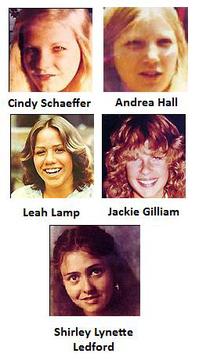

On June 24, 1979, ex-cons Lawrence Bittaker and Roy Norris, after planning for weeks to kidnap, rape, and murder young girls along the Southern California coast, spotted Cindy Schaeffer, 16, on the side of the road with her thumb out, trying to get a ride to her grandmother's house. She had the good sense to decline when Bittaker and Norris offered a lift -- but they refused to take no for an answer. They followed along, snatched her in their van, and drove her to their spot in the mountains. She was the first of five victims of the "toolbox" murderers, because Bittaker like to use hand tools to torture and kill them.
After hours of nonstop rape and torture, they each tried to strangle her with their hands. Both failed and had to resort to using a wire hanger that they wrapped around her neck and tightened with pliers. Then they dumped the body off a cliff.
Andrea Hall, 18, the second victim, willingly stepped into the van on July 8, lured by the promise of a ride and a cold drink. After a day of sexual torment, Bittaker killed her by jabbing an ice pick into each ear.
On Labor Day, Jacqueline Lamp, 13, and Jackie Gilliam, 15, stepped into a van with the two strangers who promised to take them to the beach. When they noticed that they were driving in the wrong direction, the girls tried to escape, but were violently subdued. Witnesses saw their struggle, but no one thought to call the police. Two days later, they were dead, their rapes, torments, and faces of horror caught on Polaroids. Bittaker and Norris took photographs and tape recorded the torture and killings, which made grown men, including the prosecutor, weep at Bittaker's trial.
On Halloween, Shirley Ledford, 16, was hitchhiking home from a party in a Los Angeles suburb when the van pulled up and two men offered her a ride home. Most of the sledgehammer beatings, rapes, and torture with a pair of pliers was recorded, as were her shrieks of pain and fear. She was finally strangled with a wire hanger. This time, instead of driving into the mountains, they just tossed her body onto the lawn of a house in the suburbs. A jogger found her in the morning.
There would have been more victims if Norris had kept his mouth shut. But he bragged to a former convict he had met in jail who reported to police. Norris pled guilty in exchange for life in prison; Bittaker, the ringleader, was sentenced to death. He remains alive today thanks to the endless review process created by death penalty opponents. He has discussed the killings in detail with reporters while on death row.


Great post. A week before the vote, the public could use reminding of what death penalty opponents want to shove behind the curtain while they go on and on about costs (costs that in no other context give them a minute of hesitation).
The idea that a jail sentence, no matter what its length, is proportionate justice for the inhuman crimes you describe is beyond absurd.
Unless one believes that it is immoral intentionally to kill, ever (a belief that almost no one holds), the death penalty is the only fitting punishment for crimes like this.
As you correctly note, all the other issues are diversionary. No person with normal morals wants a rampant death penalty. Everyone knows justice is expensive. Everyone knows there is sometimes (but not in every case) a risk of error. But to say there is no case, ever, where we should impose the DP is just indefensible.
Unbelievably evil.
If I were to share this with those I know,
or with those with whom I work, they would
surely come back with statements such as:
... ... 'These sick creatures should be shot',
or
... ...'They should be cut into pieces and buried in an unmarked grave'.
Undemocratically, neither the views of those I know,
nor the morals of those with whom I work,
are respected by the lawmakers or the power brokers in NY.
May the victims not be forgotten in California.
People talk about the costs of the death penalty. What cost do we put on the ability of a free people to govern itself?
The death penalty has been assaulted by the chattering class, liberal politicians, politicians in robes who've imposed a "Mother, may I" regime and, worst of all, moral preeners who scoff at those with the common sense to look at these ghastly crimes and say that the person who did them simply does not deserve to be housed, fed and clothed by society any longer.
Those jurists who want to cheat the mothers, fathers, brothers, sisters, friends, family of these young women of justice promised to them are, and make no mistake about it, profoundly evil to the extent they do so by twisting the law to save Bittaker's hide.
To a certain extent, we are prisoners of politesse. Why? We should all channel our inner Macedonian and call a spade a spade.