Results matching “first”

News Scan

Executions in Arizona and Texas Today: Amanda Lee Myers of the Associated Press reports Robert Henry Moormann was executed in Arizona this morning, becoming the first inmate in the state to be executed using a new one-drug method. The execution took place just minutes away from the motel where Moormann killed his 74-year-old adoptive mother. He beat, stabbed, and suffocated her before cutting off her head, legs, and arms. He cut her torso in half and flushed all her fingers down the toilet. He was captured after asking a corrections employee to dispose of what he said were dog bones. The murder prompted Arizona to change its policy on such temporary leaves. In Texas, Michael Graczyk of the Associated Press reports the leader of the fugitive "Texas 7" gang is scheduled to die by lethal injection tonight for killing a police officer on Christmas Eve after organizing the biggest prison break in Texas history. 29-year-old Irving police officer Aubrey Hawkins was shot 11 times and run over with a stolen SUV. At the time of the escape, Rivas was serving 17 life sentences for aggravated kidnapping and aggravated robbery, and another life sentence for burglary. Prosecutors said his criminal record began at age 11, when he molested a 6-year-old relative.

Death Warrant Signed for Florida Serial Killer: Brendan Farrington of the Associated Press reports Florida Governor Rick Scott on Tuesday ordered the execution of serial killer David Alan Gore, scheduled for April 12. Gore was sentenced to death for the rape and murder of a 17-year-old girl in 1983. Gore was on probation at the time, having been released from prison four months earlier after serving time for armed trespassing. Gore and his cousin picked up Lynn Elliott and her 14-year-old friend along the side of a road. Gore pulled his gun on the girls and threatened to kill them before handcuffing them and bringing them to his house. He tied Elliot with rope and handcuffed her friend, then put the girls in separate rooms and raped them. Elliot ran from the house, naked and still bound in rope, and a naked Gore ran after her firing a gun. He caught her and dragged her back towards the house. As she struggled, he threw her to the ground and shot her twice in the head. Investigators found Elliot's body in the trunk of Gore's car in his garage. Her friend was found alive in his attic. He was also given life sentences for raping and dismembering five other women. "He did not care about anybody, he had no remorse, he's admitted it. Should have been gone a long time ago," said Elliott's father.

California State Sen. Proposes Changing Drug Possession to Misdemeanor: Patrick McGreevy of the Los Angeles Times reports California State Senator Mark Leno (D-San Francisco) proposed Monday SB 1506, which would make the possession of certain controlled substances a misdemeanor, with a punishment of no more than one year in county jail. The bill would apply to possession of drugs such cocaine, heroin, and methamphetamine, among others.
Read more here: http://www.miamiherald.com/2012/02/28/2665520/scott-signs-death-warrant-for.html#storylink=cpy

News Scan

Increasing Number of Inmates With Dementia: Pam Belluck of The New York Times reports dementia in prison is on the rise, and many prisons are unprepared to handle the fast-growing population. While there is no exact count on cognitively impaired inmates, prisoners appear to be more prone to dementia than the general population because they often have more risk factors. New York has established a separate unit for cognitively impaired inmates who are cared for by professional caregivers, which comes with a high price tag. Other states, including Pennsylvania, are giving mental health workers special dementia training. Louisiana and California are taking a less expensive but riskier approach by training fellow prisoners to care for the daily needs of demented inmates.

Riverside and San Diego Counties Releasing Inmates Early: City News Service reports Riverside County Sheriff's officials said they have already had to resort to releasing some low-level offenders early to avoid exceeding maximum capacity in county detention facilities. In the first four months under realignment, Riverside County jails have already reached 95 percent occupancy. Teri Figueroa of North County Times reports San Diego County's jail populations would have been at full capacity by April without local officials employing the tactics of shaving jail sentences and outfitting offenders with GPS bracelets. In May, the department will take the next step in cutting the jail populations by using "alternatives to custody" for lower-level offenders to make room for the more dangerous criminals.

Convicted Sex Offender Caught on Video Violating Parole: Dan Noyes of KGO reports convicted sex offender Scott Herman can be been violating his parole on store surveillance cameras at a Bay Area Walmart. Herman has had half a dozen convictions and parole violations for indecent exposure or annoying/molesting children since 1996.  "In this case, this is a guy who clearly has a problem, cannot control himself and continues to deny, deny, deny," said Chris Weaver, Herman's parole agent. Last year while Christmas shopping at a Dollar Tree in Santa Rosa, a mother caught Herman grabbing himself and leering at her 7-year-old daughter. He only served two and a half months in Sonoma County Jail for this parole violation. Herman had been out of jail for less than two weeks when Weaver tracked Herman through the GPS unit strapped to his ankle and alerted the Walmart store security to train their cameras on Herman, who was in the Valentine's Day aisle. The surveillance video shows Herman following young girls up and down the aisle, thrusting his hips at the girls, hovering over them, and touching his groin area. 


News Scan

South Dakota Legislature Approves Limiting Appeals for Condemned Inmates: Tess Fitzgerald of the Associated Press reports the South Dakota House has approved a bill already passed in the state Senate aimed at preventing death row inmates from filing repeated appeals to delay their executions. Under the legislation, in most cases condemned inmates who lost their first appeal could only file one additional appeal.

UK Court Approves Use of Facebook to Serve Legal Claims: Raphael Satter of the Associated Press reports a High Court judge in England approved the use of Facebook for serving legal claims in a case involving two investment managers who have accused a brokerage firm of overcharging them. Justice Nigel Teare, during a pretrial hearing, permitted lawyers in the commercial dispute to serve the suit against the defendant via Facebook. A spokeswoman for the Judicial Office for England and Wales said it was the first time anyone have been served through the popular social networking site "as far as we're aware."

Caller Dies While Police Prepare for Occupy March: Henry K. Lee of the San Francisco Chronicle reports Berkeley police did not dispatch an officer to a man's house after he called to report a trespasser who later beat him to death because they were keeping officers on standby for an Occupy Oakland march headed towards UC Berkeley. 13 minutes after Peter Cukor called police to report a suspicious person hanging around his property, his wife called 911 to report the assault. After walking to a nearby fire station for help, where firefighters were out on a call, Cukor returned home and was allegedly bludgeoned with a knee-high ceramic pot by 23-year-old
Daniel Jordan DeWitt. One of the officers who responded after the 911 call had seen Cukor's initial nonemergency call on his police-cruiser computer while he was about two miles away. He had volunteered to respond two to three minutes before the 911 call, but a dispatcher had reminded the officer that police officials had decided to only respond to high-priority calls that night because of the Occupy Oakland march. In a statement Tuesday, police Lt. Andrew Greenwood confirmed "only criminal, in-progress emergency calls were to be dispatched, due to the reduction in officers available to handle calls for service" as a result of the march. Greenwood said Cukor's first call was logged as a suspicious-person report and was "queued for dispatch." Those types of calls are usually quickly given to an officer, and if handled promptly, sources say an officer probably would have arrived within 10 minutes.

Open Season on Californians' Cars

Gov. Jerry Brown's prison "realignment" program has effectively declared open season on the cars of law-abiding Californians.  The criminals know very well that offenses classified as "non-violent, non-serious, non-sex" will draw minimal jail time, if any, making them effectively decriminalized, at least for the first offense.

The latest example comes from Redding, at the north end of California's Central Valley.  Colin Lygren reports for KHSL:

A Redding man is back behind bars after being arrested twice in one day, for two separate crimes. Officers arrested Nolan Telles early yesterday morning for burglarizing a truck behind the Oxford Suites on Hilltop Drive. He was taken to jail and quickly released.

Police say Telles then stole a car from the parking lot of the YMCA on Court Street.

Stolen Valor Act Argument Transcript

The transcript of oral argument in United States v. Alvarez is now available here.  Both sides received some intense questioning from some of the same Justices.

Justice Kennedy does not buy the argument that lies are completely unprotected except for "breathing space" limitations.  However, he seems inclined to uphold the act on narrower grounds, if he can find some.

The defense side argument that medal frauds harm no one appears to be a nonstarter.  Justice Sotomayor notes the outrage of legitimate medal winners.  Justice Breyer notes that the Court upheld protection of the Olympic Committee's monopoly on the word Olympics, a matter of considerably lesser moment, and says, "All right. So I'm just saying in my mind there is real harm, and there is real harm and yet I can think of instances where we do want to protect false information."

The most important exchange may be this one:

News Scan

Jail Violence Increases in Fresno County: "Our inmates have more violent histories," Fresno County Sheriff Margaret Mims said. "Before, they would have moved on to prison. Now they're staying here." Mims also said jail inmates, especially offenders awaiting sentencing, know there's a lesser chance of going to prison now, so they have a more reckless mindset. Assistant Sheriff Tom Gattie said the jail population now has more gang involvement and criminal sophistication. "Our inmates have more violent histories," Mims said. "Before, they would have moved on to prison. Now they're staying here."

Occupy Movement Takes Up Prison Reform: Chip Johnson of the San Francisco Chronicle says a new branch of the Occupy movement calling for prison reform, Occupy 4 Prisons, misses the point of incarceration - a valid form of punishment in any society, he says. Johnson reminds readers that some inmates have forfeited their freedom due to their crimes and for some, there is no acceptable re-entry plan. His article is here. John Wildermuth of the San Francisco Chronicle reports as many as 700 Occupy demonstrators gathered outside San Quentin State Prison Monday to call for prison reform. It was one of about 15 protests taking place at prisons that day.

Suspect Says He Was Visited by an Angel and Demon Before Murdering Man: Greg Bluestein of the Associated Press reports
Hemy Neuman, charged with murdering a man who had just dropped his 2-year-old off at preschool, says he was visited by a demon who sounded like Barry White and an angel who looked like Olivia Newton-John before shooting and killing Russell Sneiderman. Newman claims the angel told him to kill Sneiderman and raise his two children as his own.

Reamore here: http://www.fresnobee.com/2012/02/19/2729036/fresno-county-jail-clashes-blamed.html#storylink=cpy

Read more here: http://www.fresnobee.com/2012/02/19/2729036/fresno-county-jail-clashes-blamed.html#storylink=cpy


Read more here: http://www.fresnobee.com/2012/02/19/2729036/fresno-county-jail-clashes-blamed.html#storylink=cpy

Hawaii Prison Murder, Part II

Kent's post about the two previously convicted killers who knifed to death (with 140 stab wounds) a fellow inmate recalls one of the strongest arguments against abolition of the death penalty:  If you don't execute a cold-blooded, violent killer after his first go-round, he'll be there to do it again.  The frequency with which these second-chance murders get committed never seems to get a story in the New York Times, but failure to cover reality does not make it less real.

Not three weeks ago, I wrote about a similar episode.  The point of my post was to show how potent this argument is in death penalty debates.  I noted that, in such a debate on Sentencng Law and Policy, a dozen abolitionists chimed in, and every one of them refused even to discuss this scenario.

Abolitionists ceaselessly contend that, because the death penalty is a human institution, there is an inescapable risk that, at some point, we are going to execute an innocent person.  This is one of the things they say that's actually true (if remote).  It is thus more than fair, and very valuable, to force them to confront the fact that the failure to use the death penalty has produced, not just the possiblility, but the demonstrated fact, of sacrificing the lives of the innocent, and has done so again and again.

News Scan

Decision on Utah's Immigration Law Delayed: Josh Loftin of ABC News reports U.S. District Judge Clark Waddoups said Friday he will decide in a few days whether to rule on the constitutionality of Utah's immigration enforcement law or keep the temporary injunction issued 8 months ago in place until after courts rule on a similar law in Arizona. Utah's version would allow police to check the citizenship of anyone they arrest in cases involving a felony or class-A misdemeanor. Utah Assistant Attorney General Barry Laurence argues Utah's law simply reflects existing federal law, but U.S. Justice Department attorney Josh Wilkenfeld argues that the law is attempting to trump federal law.

16 Offenders Pardoned by Barbour Were Rejected by the Mississippi Parole Board: The Associated Press reports Haley Barbour issued full pardons in his final days as governor for 16 inmates whose requests for pardons were rejected by the Mississippi Parole Board. State Rep. Cecil Brown of Jackson (D) requested the Joint Legislative Committee on Performance Evaluation and Expenditure Review (PEER) examine Barbour's pardons. The 16 offenders had been convicted of crimes ranging from methamphetamine possession to murder. Furthermore, 13 of the 16 cases received unanimous votes from the Parole Board rejecting the inmates' requests for pardons. A change is being sought in the state to limit gubernatorial pardon power to require that governors follow Parole Board recommendations. Rep. David Baria (D) also wants to ban governors from issuing pardons during their last 90 days in office.

DNA Samples From Felony Suspects Lead to 132 Arrests in Ohio: Jessica Heffner from Springfield News-Sun reports a new program requiring DNA samples from anyone arrested for a felony in Ohio has led to 132 arrests in cold cases including rapes, murders, robberies, and burglaries. Since Senate Bill 77 went into effect July 1, 2011, the lab has processed 63 percent more DNA samples, and connected those samples to an average of 127 cases per month. With over 10 million samples in CODIS, many more arrests are expected to follow. Furthermore, proposed Ohio Senate Bill 268 would allow DNA to be collected from those charged with a felony but not arrested. This includes those summoned to court. The bill would also allow the retroactive collection of DNA from people arrested for a felony prior to July 1, 2011. That bill was passed unanimously by the Ohio Senate, and is now in the state House of Representatives.


State Appeals Court Rules NY Parole Procedure Unconstitutional:
Joseph Ax of Reuters reports a state appeals court ruled unanimously Tuesday that New York's parole procedure is invalid and violates state and constitutional law. The procedure allows a unilateral overruling of the hearing officer's decision by a single member of the state parole board in cases in which the parolee was convicted of homicide, sex crimes, or kidnapping. The five-judge panel held that the parole procedure is in conflict with the purpose of the underlying state statute. The court said the legislature intended for hearing officers to have the final say on the amount of time between a parole violation and possible re-release. The state attorney general's office said it had not yet reviewed the decision. 

Missing-Person Inquiries Stem From Excavation of Serial Killers' Burial Sites:
Emmett Berg from Reuters reports that after five days of excavation, nearly 1,000 human bone fragments have been recovered in the first of five burial sites identified by Wesley Shermantine, one of the so-called Speed Freak Killers. A telephone hot-line was set up by investigators assigned to the case, which has led to roughly 65 queries about missing persons who callers fear may have been victims of Shermantine and Loren Herzog. Deputy Les Garcia, a spokesman for the San Joaquin County Sheriff, said there was no way of knowing yet how many victims might be found at the sites. 

News Scan

Over 1,000 Old Detroit Rape Kits to be Tested: Corey Williams from the San Francisco Chronicle reports that more than 1,000 rape kits going back to the 1980s found in a Detroit police property storage facility are being reviewed by State police, Detroit police, the Wayne County prosecutor's office, and researchers at Michigan State University to determine which could lead to arrests. DNA testing will be conducted in an outside lab. DNA found in the kits that do not belong to victims will be loaded into the FBI's Combined DNA Index System (CODIS) to search for matches that could lead to arrests.

California Privacy Laws Keep Police From Knowing Names of Released Offenders: Kate McGinty from The Desert Sun reports current state privacy laws were overlooked by California lawmakers when they enacted the state's realignment legislation. State privacy laws prevent probation agents, who will now monitor most offenders after they are released from prison, from giving out the names of those back in the community to local police. Sheriff Stan Sniff Jr. said his department has relied on crime pattern analysts to help fill in the lack of information. "When they inflicted this AB 109 on us, they did not think it through," Sniff said.

First Racial Justice Act Case Comes to a Close: Ashby Jones from the Wall Street Journal reports Cumberland County Judge Gregory A. Weeks heard closing arguments Wednesday as to whether race played an improper role in the death penalty conviction of Marcus Raymond Robinson in the first case tried under North Carolina's Racial Justice Act. Robinson was convicted in 1994 of murdering a 17 year-old white male during a robbery. Under the state's Racial Justice Act, enacted in 2009, there is no requirement that a defendant prove bias took place in his case specifically. An inmate only needs to prove, with statistics, that race was a significant factor in the prosecutors' and jurors' decisions concerning the death penalty "in the county, the prosecutorial district, the judicial district, or the State at the time the death sentence was sought or imposed." Judge Weeks' decision is expected to come in the next few weeks.

ACLU Hiring Realignment "Watchdogs": The San Diego and Imperial Counties chapter of the ACLU in California has hired a watchdog to "keep an eye" on how the changes realignment have brought are being implemented, and to oversee criminal justice and drug policies. The story by Teri Figueroa of North County Times is here.  

News Scan

New York City Spree Killer Gets Additional 25 Years: The Associated Press reports Maksim Gelman will get an additional 25 years added to his 200 year sentence in prison for a stabbing and carjacking killing spree which claimed four lives. After an argument with his mother over using her car, Gelman proceeded to kill his stepfather, a woman who Gelman was reportedly obsessed with, the woman's mother, and a pedestrian Gelman ran over. The additional sentence is for slashing a Manhattan subway passenger, who survived and helped knock Gelman down before police arrested him.

Missouri Lawmaker Seeks Death Penalty Audit: The Associated Press reports Missouri State Senator Joe Keaveny filed a bill seeking an audit on death penalty costs within the state. The audit would compare the costs of the death penalty to that of life in prison without parole. According to Keaveny, the goal is to determine the cost of the death penalty and not to analyze the effectiveness of capital punishment as a deterrent to crime. This would be the first such audit in Missouri.

South Carolina Considers Death Penalty in Home Invasion Cases:
Sean Maginnis from WMBF News reports South Carolina state lawmakers are considering a bill that would add home invaders responsible for a murder to be eligible for the death penalty. Currently, criminals convicted of burglary, armed robbery, or kidnapping charges combined with murder are eligible for a death sentence. The bill would have a minimal impact on statutes already in place, but could provide prosecutors an additional tool for pursuing sentences. It would also potentially increase the length of home invasion crime penalties. Several versions of the bill are currently being considered.

Fugitive Calls Sheriff for Help After Running Out of Gas: The Associated Press reports Richard Vincent, 59, wanted in Georgia for violating parole on a murder and escape conviction, called the local sheriff's office for roadside assistance when he ran out of gas in Wyoming. The state troopers that were sent out took Vincent into custody when they realized he had an outstanding felony warrant. He is now being held for Georgia authorities pending extradition. 

Read more here: http://www.bnd.com/2012/02/15/2059015/mo-lawmaker-wants-audit-for-using.html#storylink=cpy

News Scan

Serial Killer Leads Officials to Hundreds of Human Bone Fragments: Sam Stanton of The Sacramento Bee reports authorities discovered 300 human bone fragments on the fourth consecutive day of searching for possible victims of two California serial killers. The search for victims of Loren Herzog and Wesley Shermantine, the so-called "Speed Freak Killers" believed to have killed over a dozen people in the 1980s and 1990s, is expected to continue today. On Thursday, a skull was found in Calaveras County that was identified as that of Cyndi Vanderheiden, who disappeared in 1998. Another skull was found at a different burial site in Calaveras County Friday that is believed to be that of Chevelle "Chevy" Wheeler, a 16-year-old who disappeared in 1985. Shermantine has supposedly indicated that there may be up to a dozen victims at the site. He recently provided a map to Stockton Record reporter Scott Smith that authorities have been using to locate burial sites. Herzog killed himself last month, and Shermantine, who is on death row, now says that all the killings were all done by Herzog.

New Statute on Maryland's Death Penalty Tested: Andrea F. Siegel of The Baltimore Sun reports the sentencing of Lee Edward Stephens this week will be the first time under Maryland's new death penalty law that prosecutors must establish whether the DNA evidence "links the defendant to the act of murder." Stephens was convicted last week of first-degree murder for fatally stabbing a correctional officer. Stephens was in prison, serving a sentence of life plus 15 years for murdering a man outside of a nightclub in 1997, when he and another inmate ambushed the correctional officer. In 2009, Maryland limited the death penalty to first-degree murder cases in which there is biological or DNA evidence, a video recording of the crime, or a videotaped confession. Stephens must decide whether he wants to be sentenced by the jury that convicted him or the presiding judge, who will have to decide if the evidence that the victim's blood was on the defendant's clothes is conclusive enough to consider the death penalty.

News Scan

Washington Considers Collecting DNA Upon Arrest: Gene Johnson of the Associated Press reports Washington state's Legislature is considering requiring people to give DNA samples when they are arrested for serious crimes, instead of waiting until there is a conviction. Under bills in the Washington Legislature, DNA would be collected from people arrested for almost all felonies or for violating a domestic violence protection order. The State Patrol crime lab could test the DNA and enter the profile created in a nationwide database once a judicial officer declares the arrest supported by probable cause. If a person is not charged or exonerated, they could petition to have their sample and profile destroyed by the crime lab. The crime lab could run a check on the profile first before destroying it.   

Arizona Inmates Sue Over Execution Protocol: Amanda Lee Meyers of the Associated Press reports three inmates on Arizona's death row filed a lawsuit in federal court in Arizona Monday against the governor, the state corrections director, and those who conduct executions. The inmates claim the state's new execution protocol violates their constitutional rights, and seek to have two of their upcoming executions delayed. The inmates suing are Robert Henry Moormann, Robert Charles Towery, and Pete Rogovich. Moormann is scheduled to be executed February 26 for killing and dismembering his adoptive mother while on a "compassionate" furlough from prison. Towery is scheduled to be executed March 8 for killing a man while robbing his home. Rogovich, whose executed has not be scheduled, was sentenced to death for a crime spree in which he robbed two business and killed four people.

Cop Killer Formally Sentenced to Death: Sam Cohen of FOX40 News reports Marco Topete was formally sentenced to death by a Yolo County judge Tuesday for killing a Yolo County sheriff's deputy in 2008. The judge also denied the defense's motion seeking a new trial. See previous posts about this case here and here.

Shootings by Sheriff's Deputies Already Surpass Previous Year's High: Kim Minugh of The Sacramento Bee reports Monday was the sixth time this year a Sacramento County sheriff's deputy has fired their gun during a confrontation with a suspect. With six officer-involved shootings just thirty-seven days into 2012, the Sheriff's Department has surpassed the total for 2011 - five - and has matched its average yearly total. Sheriff Scott Jones said he is most concerned that the spike in incidents suggests that "the streets and our community are becoming increasingly hostile and dangerous places for my officers to work."    

News Scan

After 44 Arrests and No Convictions, Man Now Faces 32 Years: Nathan Gorenstein from the Philadelphia Inquirer reports John Gassew, 25, who avoided any sort of a conviction in state courts despite having been arrested 44 times, will now serve at least 32 years in federal prison. The primary reason for the previous lack of convictions is that victims failed to appear in court to testify. In the first of two robberies he was convicted for, Gassew held up a 7-Eleven and beat a store clerk with a .45-caliber semiautomatic pistol. Gassew then proceeded to drive a stolen truck into a tree, drawing police attention, and fled the scene, leaving his gun behind in the vehicle. After two days of jury deliberation, Gassew was found guilty of two counts of robbery and two counts of violating the Hobbs Act by carrying a firearm during the commission of a violent crime. Federal prosecutors have used the Hobbs Act to charge robbers who hit gas stations, convenience stores, and other businesses that can be shown to be involved in interstate commerce. He will be formally sentenced in May.

Mississippi Supreme Court to Take Pardons Case: The Associated Press reports the Mississippi Supreme Court said Wednesday it will take up the legal challenge to the pardons issued by outgoing Governor Haley Barbour. State Attorney General Jim Hood wants to invalidate dozens of the 198 pardons Barbour handed out. Hood says only about two dozen of those pardoned followed the Mississippi Constitution's requirement to publish notice about their reprieve in their local newspapers for 30 days. Ten of the people who received full pardons were still incarcerated when they received the reprieves. "It's a core question of separation of powers between the branches of government. It's an important question that the Supreme Court has to answer," said Matt Steffey, a constitutional law professor at Mississippi College. The state Supreme Court set a hearing for February 9.

Teacher Charged With 23 Counts of Lewd Conduct in Classroom Keeps Benefits: Howard Blume of the Los Angeles Times reports former elementary school teacher Mark Berndt, who is charged with 23 counts of lewd conduct in his classroom including spoon-feeding his semen to blind-folded children, will retain his life-time health benefits from his school district in addition to his pension because he technically resigned and was never officially fired. Vivian Ekchian, chief human resources officer for L.A. Unified, says the district is looking at its options for trying to rescind those benefits if Berndt is convicted. His retirement benefits are not at issue, because "a teacher will receive their pension regardless of the reason for their termination" said Michelle Mussuto, a spokeswoman for CalSTRS.

News Scan

Appeals Court Upholds Stolen Valor Act: Ivan Moreno of the Associated Press reports the 10th U.S. Circuit Court of Appeals ruled Friday that the Stolen Valor Act is constitutional. The ruling reverses a district court's decision that the Stolen Valor Act violates the First Amendment, saying the U.S. government had not presented any compelling reason to restrict that specific type of speech. That case out of Colorado involves Rick Strandlof, who founded a veterans group and said he had received the Purple Heart and Silver Star. He was charged with violating the law in 2009 and his case was later dismissed by a federal judge. The opinion from the 10th U.S. Circuit Court of Appeals is here. The U.S. Supreme Court will take up the issue in February in the case of United States v. Alvarez, after the 9th U.S. Circuit Court of Appeals struck down the law. CJLF's brief with the Legion of Valor for that case is here

NY Bar Association Proposes Removing Some Felonies From Public Records: Russ Buettner of The New York Times reports the New York Bar Association's proposal to create a way to remove some nonviolent felony convictions, under certain conditions, from a person's public record was approved Friday by the association's House of Delegates. The change would allow misdemeanor convictions and a single nonviolent felony conviction under certain circumstances to be sealed with the approval of a judge. An offender would have to wait five years after a misdemeanor conviction or eight years after a felony conviction, without committing any crimes during the waiting period, before the record could be sealed. Sealed records would become public again if an offender committed another crime.

First Trial Under Racial Justice Act: Paul Woolverton of The Fayetteville Observer reports the first hearing in North Carolina under the Racial Justice Act began today for Marcus Reymond Robinson, who was sentenced to death for robbing and killing a 17-year-old boy in 1991. Robinson's Racial Justice Act claim says prosecutors dismissed half of the black jurors and only 15 percent of the non-black jurors. The victim's stepmother said the court system wasn't racist, but Robinson was. He is black, and his victim is white. She said a witness testified at the trial that Robinson said he was going to "kill a whitey."

Abolitionism Runs Aground

A few days ago, I put up an entry about a previously convicted killer serving LWOP who knifed to death a prison guard.  The next day, the story was picked up by Sentencing Law and Policy, a popular legal blog.  SL&P, although center-left in its orientation, noted that a case of that sort makes it very problematic categorically to oppose the death penalty.

The story generated (so far) 68 comments, which is a very large number by the standards of that blog.  A dozen abolitionists chimed in.  I repeatedly asked them the following question:

"What punishment, short of the death penalty, do you suggest for this case that is (1) consistent with the Eighth Amendment, (2) likely to deter LWOP inmates from murder, and (3) proportionate to the offense?"

I first posed the question five days ago.  Most readers of C&C will not be surprised to learn that, through all 68 comments, not a single abolitionist has answered it. 

The reason is not that hard to figure out.  They don't have an answer. 

So in what condition does that leave abolitionism today?  

News Scan

Execution Today in Texas: Michael Graczyk of the Associated Press reports Rodrigo Hernandez is scheduled to be executed by lethal injection in Texas today for the the abduction, rape, and strangulation of a 38-year-old woman in San Antonio in 1994. Hernandez attacked her at a storage area behind a supermarket and dumped her body in a garbage barrel behind a church. The murder went unsolved for eight years until he had to submit a DNA sample as a requirement for parole in Michigan, where he was serving a sentence for using a bottle to severely beat a man. His DNA sample went into a national database, which linked Hernandez to the Texas murder. Two years ago, DNA evidence also linked him to the 1991 slaying of a 77-year-old homeless woman in Michigan. He was not tried for her death. It would be the first execution in Texas this year.

Juvenile Sex Offenders Must Report for 25 Years: Bob Egelko of the San Francisco Chronicle reports the U.S. Ninth Circuit Court of Appeals Wednesday upheld that juveniles convicted of serious sex crimes in federal court can be required to register as sex offenders for at least 25 years. The Ninth Circuit said a registration law passed by Congress in 2006 that removed sex offenders aged 14 and over from the confidentiality protections of federal juvenile justice law is constitutionally sound. The ruling upheld registration requirements for three Montana juveniles subjected to federal prosecution because they committed forcible sex crimes between ages 14 and 17 on Indian reservations. The opinion is here.

Supreme Court GPS Tracking Case Confounds the Press:
Tom Goldstein, writing for SCOTUSblog, explains how he thinks the press got Monday's U.S. Supreme Court decision regarding GPS tracking in United States v. Jones wrong. He says the Court's only holding is that the installation of a GPS monitoring device is a search, which is a different question from whether it requires a warrant and whether it requires probable cause. The Court did not decide whether the short-term monitoring of a GPS device is a search requiring a warrant. Goldstein says in general, the coverage of Jones is bad and misleading, with none of the pieces correctly characterizing the ruling and its limits. He says the early press coverage focused on the warrant question because the public knows what that means. 

Preventable Murder, Part Eight Zillion

As I noted last week, the failure to impose the death penalty on violent and dangerous killers gives them the opportunity to do it again.  Every now and again they do; indeed, there are more than 100 instances of killing by inmates previously convicted of murder (there may be many more than that; I lost track years ago).  If abolitionists view these murders as even regrettable, much less as a serious moral problem, I have yet to hear about it.

Reader federalist alerts me to three more preventable murders that were committed recently in Florida.  These were not because of a prior failure to impose capital punishment, but they stem from the same clueless Give Peace A Chance "thinking" that oozes from the abolitionist mind.

The story is that when twice-convicted felon Kelser Dufrene, an immigrant from Haiti, was released from his most recent prison sentence (his first arrest was at age 14), he was supposed to be deported.  But it never happened because, even though ICE authorities had him in custody, they let him loose under an Obama administration edict that no one could be deported to Haiti in light of the damage and chaos in that country wrought by the earthquake two years ago.  Instead, ICE released him to prey upon the legal residents of Miami, which he promptly did by killing three of them, including a 15 year-old girl.

The story is here, and the moral of the story is that as long as the criminal justice system allows gushing sentiment to replace hard thinking about what's going to happen next, this sort of travesty is certain to repeat itself. 

News Scan

CA Woman Who Killed 2 Sons and Husband Gets Death Penalty: Terri Vermeulen Keith of City News Service reports Manling Tsang Williams, convicted in 2010 of killing her 3- and 7-year-old sons and her husband while they were asleep, was sentenced to death in Pomona Superior Court Wednesday. After putting on gloves and smothering her two sons with a pillow in their bunk beds, prosecutors alleged that Williams checked the MySpace page of her lover, went out with friends, and then returned home and attacked her husband with a sword, inflicting more than 90 wounds on him. Prosecutors said she killed her family because her lover indicated he was going to break up with her because she was married with children. Before handing down the death sentence, Pomona Superior Court Judge Robert Martinez also rejected a motion for a new trial.

Federal Official Pleads the Fifth on Fast and Furious: William La Jeunesse of Fox News reports the chief of the Criminal Division of the U.S. Attorney's Office in Arizona informed the House Oversight Committee Thursday through his attorney that he will use the Fifth Amendment protection and not testify before Congress regarding Operation Fast and Furious. Patrick J. Cunningham's lawyer says the Department of Justice is making him the fall guy. Cunningham says he is a victim of a conflict between two branches of government, and will not be compelled to make a statement that could later be used to indict him on criminal charges. This is the first big rift in the government's united defense of itself in the gun-running scandal.

Gang Members Arrested After Bragging About Murders on Social Media Sites: Aman Ali of Reuters reports 43 feuding gang members were arrested in New York Thursday in connection with three murders and a series of shootouts that led to the wounding of several others after bragging about the shootings on Facebook, Twitter, and YouTube. The gang members were indicted on charges including murder, assault, reckless endangerment, robbery, and weapon possession. Potential sentences range from a year to life in prison. "By linking their postings and boastings to active cases and other crimes, these officers were able to build their case," New York Police Commissioner Raymond Kelly said.

The US Supreme Court decided the decidedly odd procedural default case of Maples v. Thomas this morning.  "The sole question this Court has taken up is whether, on the extraordinary facts of Maples' case, there is 'cause' to excuse his procedural default."  As noted in my post of July 13, the essential facts are:

Maples is a double murderer who was represented by the big-name New York law firm of Sullivan & Cromwell for his state collateral review petition.  However, the big shots blew the deadline to appeal because (1) they didn't bother to inform the state court of a change in the attorneys handling the case; (2) the firm had a strange policy of not letting the attorneys use the firm name in their appearance -- even though the firm touts the work on its web site; and (3) when notices of decision addressed to the individual, departed attorneys arrived at the firm's mail room, the mail room sent them back to the court.

On "the extraordinary facts," it is not too surprising that the Court answered the question "yes."  See my post after the oral argument.  As predicted, the resulting precedent is narrow, at least for the time being.  One aspect of the opinion that I find particularly disappointing is what it does and does not say regarding who is to blame for the mess.

First, and most importantly, is the narrowness of the opinion.  The Court does not back off from Coleman v. Thompson.  Attorney error in habeas is not "cause" for default, even something as basic as blowing an appeal deadline.  "We do not disturb that general rule."  Abandonment is distinguished from error.  Look for petitioners' briefs to push an ever-expanding definition of abandonment from this point onward.  Hopefully, the courts won't go for it and not much damage will be caused.

News Scan

Executions Scheduled in Nebraska and Oklahoma: Joe Duggan of the Omaha World Herald reports the Nebraska Supreme Court has set a March 6, 2012 execution date for cult leader Michael Ryan. Ryan ordered one of his followers to undergo torture that included sodomy, the shooting of his fingertips, and partial skinning by a knife, and was convicted of his first-degree murder. He was also convicted of second-degree murder in the killing of a 5-year-old boy who was the son of a cult member. The last execution in Nebraska was in 1997 by electric chair. Ryan would be the first inmate executed in Nebraska by lethal injection. Rachel Petersen of McAlester News (OK) reports the Oklahoma Court of Criminal Appeals set February 16, 2012 as the execution date for Garry Thomas Allen, who murdered his wife in 1986.

CA Serial Killer Found Dead:
Mike TeSelle of KCRA (Sacramento) reports triple-murderer Loren Herzog was pronounced dead from an apparent suicide. He had been living in a trailer outside the front gate of the High Desert State Prison in Susanville, CA since his release in September 2010. Herzog was originally sentenced to 78 years to life in prison, but pleaded down to voluntary manslaughter after his conviction was overturned on appeal when it was ruled that his statements were illegally coerced. Herzog served 11 years in prison. His co-defendant, Wesley Shermantine, is currently on death row in California. A news release from the Lassen County Sheriff said "an official determination related to the cause of death won't be made until after the investigation and an autopsy are completed."

What CA Prison Realignment Has Wrought So Far:
Brik McDill, a senior supervising psychologist at the California Correctional Institution in Tehachapi, has this opinion piece in the Bakersfield Californian about the effects so far of Governor Brown's inmate realignment law (AB109), which went into effect last October. He says at this point there are many foreseeable problems and few solutions.

Jerry Brown Proposes Cutting $1 Billion From Prisons: Marisa Lagos of the San Francisco Chronicle reports California Gov. Jerry Brown wants to cut state prison funding for the first time in nearly a decade by $1.1 billion next fiscal year. Referring to the general fund spending on the California Department of Corrections and Rehabilitation, Brown said Friday, "we're knocking it down, and we'll knock it down further." State Assemblyman Jim Nielsen (R), a former parole board chairman, predicts the savings will not last in the long-run, and says any savings for taxpayers would be eliminated by counties having to ultimately raise local taxes to fully pay for realignment.

Rhode Island Bill Would Reinstate Death Penalty: The Associated Press reports Rhode Island Senator John Tassoni (D) and two other state senators have introduced a bill to reinstate the death penalty in Rhode Island. He says the legislation was motivated by Rhode Island Gov. Lincoln Chafee's decision last year to keep a man accused of murder in state custody, when he could have faced the death penalty in federal court. The death penalty would be authorized in the state for those convicted of first-degree murder with one of seven listed aggravating circumstances. The text of the bill is here.

Disproportionate to What?

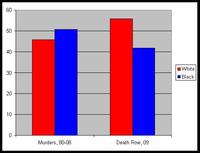
RaceMurdDP.jpg
In last night's Republican presidential debate, transcript here, Juan Williams asked Ron Paul a question about race and drug offenses.  Paul chose to go off the rails and talk about the death penalty, demonstrating once again that he is both erratic and misinformed.

"Yes. Definitely. There is a disparity. It's not that it is my opinion, it is very clear. Blacks and minorities who are involved with drugs, are arrested disproportionately. They are tried and imprisoned disproportionately. They suffer the consequence of the death penalty disproportionately. Rich white people don't get the death penalty very often."

Disproportionate to what?  The graph on this page shows the racial composition of murderers in America (in cases where the race of the perpetrator is known) and the racial composition of death row.  White murderers make up a significantly larger proportion of death row than they do of murderers in general.

Paul gets his "disproportionate" number, apparently, by committing the common Fallacy of the Irrelevant Denominator.  The percentage on the right pair of bars would be "disproportionate" if compared to the racial composition of the general population.  But that is irrelevant.  Death row is not for the general population; death row is for murderers.  It's discouraging I even have to say that, given how simple and obvious it is, but we see this same fallacy over and over.

Rich people rarely get the death penalty because rich people rarely commit capital murder.  It does happen, though.  Thomas Capano got the death penalty.  Robert Marshall got the death penalty.  Scott Peterson wasn't rich, but he did get the lawyer to the stars; he is on death row.  If O.J. Simpson had been white, he would certainly be in a California prison for his double murder and probably on death row.

This isn't the first time Ron Paul has demonstrated his ignorance on the death penalty.  CJLF's press release from last August is here.

News Scan

Maine Makes Database of Probationers Public: Heather Steeves of Bangor Daily News (ME) reports a new database created for the Maine Department of Corrections allows people to search for those on probation in the state. The department said the goal is to reduce the workload for corrections staff who handle information requests by allowing victims to track their abusers. The Department of Corrections lists the locations of probationers only by the city where their regional office is located. The database is updated daily.

Upcoming Executions in Arizona and Pennsylvania: Michael Kiefer of The Republic (AZ) reports the Arizona Supreme Court Tuesday approved execution dates for Robert Moormann and Robert Towery. Moormann will be executed February 29, and Towery will be executed March 8. Towery strangled a man to death in 1991 during a robbery of the victim's home. Moormann killed his adoptive mother during a "compassionate furlough" from prison in 1984, where he was already serving time for kidnapping. He cut her body into pieces and dumped them in garbage cans around the city of Florence, AZ. Warren Howeler of the Morning Times (PA) reports Pennsylvania Governor Tom Corbett Monday signed the execution warrant for Dustin Ford Briggs, who is scheduled to be executed March 8. Briggs was convicted for the 2004 shooting deaths of two sheriff's deputies.

Homicide No Longer a Top Cause of Death: Mike Stobbe of the Associated Press reports homicide has been dropped from the list of the nation's top 15 causes of death for the first time in 45 years. It is unclear whether it means homicide was off the list 46 years ago, or if the list has only been around for 45 years. The report from the National Center for Health Statistics is here. Update: This article by David Brown in the WaPo clarifies that homicide entered the top 15 in 1965.

Ohio Judge Halts Upcoming Execution: Andrew Welsh-Huggins of the Associated Press reports U.S. District Court Judge Gregory Frost Wednesday delayed the January 18 execution of Charles Lorraine in Ohio. Lorraine stabbed a 77-year-old man five times with a butcher's knife and stabbed his 80-year-old wife nine times before burglarizing their home in 1986. Frost said the state diverted from its execution policies when it failed to document the drugs used in its last execution in November and failed to review the medical chart of the inmate before the execution. Ohio is appealing the judge's order.

Another Ugly Nawlins Case

The Big Easy is really good at partying, but apparently not so good at disclosing exculpatory information to the defendant, as required by Brady v. Maryland, 373 U. S. 83 (1963). Last term, we had Connick v. Thompson, a civil case about failure to disclose a crime lab report.  Today we have Smith v. Cain, about failure to disclose prior inconsistent statements by the only witness who identified the defendant at trial.

This is about as pure a Brady claim as they come.  As CJ Roberts explains, the jury might have believed the witness's trial statements rather than the prior statements, but "might" is not the test.

The State and the dissent advance various reasons why the jury might have discounted Boatner's undisclosed statements. They stress, for example, that Boatner made other remarks on the night of the murder indicating that he could identify the first gunman to enter the house, but not the others. That merely leaves us to speculate about which of Boatner's contradictory declarations the jury would have believed. The State also contends that Boatner's statements made five days after the crime can be explained by fear of retaliation. Smith responds that the record contains no evidence of any such fear. Again, the State's argument offers a reason that the jury could have disbelieved Boatner's undisclosed statements, but gives us no confidence that it would have done so.
This case is a straightforward application of settled law to particular facts that makes little new law.  Why did the Supreme Court take it up?  Wouldn't Smith have been granted relief on federal habeas from the state court's unreasonable rejection of his claim?  Isn't that why Congress adopted the compromise standard of 28 U.S.C. §2254(d), rather than getting rid of federal habeas for state prisoners altogether?

Or does the Supreme Court lack confidence that the Fifth Circuit will grant habeas relief where the 2254(d) standard requires it (i.e., clearly wrong state court decisions), just as it lacks confidence that the circuits divisible by 3 will observe that standard and refrain from second-guessing state courts on close questions, as Congress has required?

The politics of federal judicial appointments, unfortunately, results in the states that need the most federal scrutiny receiving the least and vice versa.  The voters who choose the governor who appoints the state judges, or who elect the state judges directly, also choose the senators who have large influence over the appointments of the federal district and circuit judges in their states.  Less home-state-senator influence over the circuit appointments, at least, would help balance things out.  The political realities being what they are, though, I am not hopeful that can be done.

News Scan

CA Supreme Court Overturns Death Sentence: Bob Egelko of the San Francisco Chronicle reports the California Supreme Court Monday issued its second death sentence reversal in two months after upholding 46 consecutive death sentences over two years. The court upheld the conviction for Kevin Pearson, but unanimously overturned his death sentence and granted him a new sentencing trial. Monday's ruling found improper dismissal of a juror when Superior Court Judge Tomson Ong granted a prosecution request to remove a juror from the panel because she wrote in her questionnaire that she wasn't sure how she felt about capital punishment. The court's decision said that the juror's views on the death penalty would not have prevented or substantially impaired the performance of her duties as a juror, and the improper removal denied Pearson an impartial jury. The court's opinion is here.

DNA Links Florida Man to Murder 20 Years Ago: WFTV Channel 9 (FL) reports David Hedrick was arrested in connection to a homicide two decades ago after taking a DNA test for failing to pay his taxes in Florida, a felony offense. In Florida if someone is convicted of a felony, a DNA sample is taken and run through a database. Deputies said Hedrick's DNA matched blood samples taken from the 1991 crime scene where 50-year-old Betty Foster was stabbed 25 times in the neck and chest. 

Last Inmates Leave 150-Year-Old Nevada Prison:
The Associated Press reports the last of the inmates were transferred from Nevada State Prison Monday. Established in 1862, Nevada State Prison houses Nevada's execution chamber and license plate factory. It was the site of the nation's first execution in a gas chamber in 1924. The historic prison has numerous structural problems. In some units, faulty plumbing forced guards to leave cell doors open so inmates could use toilets down the hall. Officials estimated it would have cost $30 million to bring the prison up to code. 

Realignment for Juveniles: Nannette Miranda of abc30/KFSN-TV reports that under California Governor Jerry Brown's latest budget proposal, the responsibility for managing youth offenders would be transferred from the state's youth prisons to local jurisdictions. The Division of Juvenile Justice currently houses approximately 1,100 offenders. Just 15 years ago, it housed approximately 10,000 juvenile offenders. Brown's budget proposes stopping the intake of new juvenile offenders January 1, 2013, and proposes giving counties $10 million in 2011-2012 to plan for the transition.


News Scan

Obama Admin Eases Deportation Rules: Stephen Dinan of The Washington Times reports the Obama administration Friday proposed new rules that would make it easier for illegal immigrants applying for legal status to stay in the U.S. if they have a spouse or parent living here legally, and would be subject to "hardship" if separated. Department of Homeland Security officials said the goal is to reduce the time that illegal immigrants are separated from their families while awaiting a decision on their application for visas. Under a 1996 law, illegal immigrants are barred from coming back to the U.S. for three to ten years, depending on how long they were in the country illegally. In the fiscal year 2011, U.S. Citizenship and Immigration Services received 23,000 hardship waiver applications and approved about 17,000 of them.     

First Conviction in U.S. for Organ Transplant Tourism:
International Medical Travel Journal reports New York resident Rabbi Levy Izhak Rosenbaum pleaded guilty to illegally buying kidneys from live Israeli donors, which were transplanted into three New Jersey residents, becoming the first person in the U.S. to be convicted of selling and trafficking human organs. Rosenbaum's sentencing is set for February 2, 2012.

CA Supreme Court Mulls Expanding Window for Clergy Abuse Claims: Lisa Leff of the Associated Press reports the California Supreme Court Thursday heard arguments for a case that could allow adults who only recently connected their psychological problems to the abuse they suffered as children to seek damages. The case involves six brothers in their 40s and 50s who alleged they were molested by an Oakland priest in the 1970s, but didn't link it to their chronic distress until 2006. Irwin Zalkin, the brothers' lawyer, urged the court to resist the temptation to deny his clients because of concerns that it would "open the floodgates" to more clergy abuse lawsuits. The state Supreme Court has 90 days to issue its ruling.

City of Chowchilla to File Legal Challenge Against Prison Conversion: Joshua Emerson Smith of the Merced Sun-Star reports the California city of Chowchilla said Thursday it plans to file a petition for writ of mandate in Madera Superior Court challenging the state prison system's notice of exemption to CEQA in the California Department of Corrections and Rehabilitation's attempt to convert the Valley State Prison for Women into a men's prison. The city hopes the legal action will force prison officials to conduct a formal study under the California Environmental Quality Act of the conversion's impact on the city and county. In December, prison officials stated they would not conduct a study of the conversion under CEQA because the conversion would "simply reorganize inmates" and "not affect the physical environment." Locals fear that the families of male inmates will relocate to the area at a higher rate, overwhelming the city's limited resources.     

Rmore here: http://www.mercedsunstar.com/2012/01/05/2180047/city-of-chowchilla-to-take-legal.html#storylink=cpy

Read more here: http://www.mercedsunstar.com/2012/01/05/2180047/city-of-chowchilla-to-take-legal.html#storylink=cpy

Read more here: http://www.mercedsunstar.com/2012/01/05/2180047/city-of-chowchilla-to-take-legal.html#storylink=cpy

Read more here: http://www.mercedsunstar.com/2012/01/05/2180047/city-of-chowchilla-to-take-legal.html#storylink=cpy

Read more here: http://www.mercedsunstar.com/2012/01/05/2180047/city-of-chowchilla-to-take-legal.html#storylink=cpy
 

Study on Truth-in-Sentencing

Some years back, "truth in sentencing" laws were passed in many jurisdictions to ensure that criminals or a defined subset of criminals actually served all or most of the prison time they were sentenced to.  These laws were and remain controversial.  A new report from Arizona supports the crime-reducing impact of that state's TIS law and of such laws in general.  The full report is over 500 pages and will take some time to digest. The Maricopa County* Attorney has this press release.  Bearing in mind that press releases about studies must always be taken with a grain of salt, here is the first paragraph:

Arizona has prevented more than a million crimes since 1994 by incarcerating its most dangerous criminals, according to a major research study released today. Titled Prisoners in Arizona: Truth-in-Sentencing, Time Served and Recidivism, the study concludes that Arizona's Truth-in-Sentencing (TIS) laws, which ensure that convicted criminals serve at least 85% of their sentence, led to a 17.7% drop in reported crime over a fifteen year period after TIS laws were enacted in 1994.

*Phoenix and vicinity, with over half the population of the state.

News Scan

First Execution of 2012: The first execution of the new year is scheduled for 6pm tonight in Oklahoma. Gary Welch is on death row for stabbing a man to death in 1994. He has refused to apologize for the slaying. "Gary Welch had a 15-year history of violent crimes that included multiple assaults on women and police officers, burglary, stabbings and carrying concealed weapons before his conviction for murder...  My thoughts are with Robert Hardcastle's family and what they have endured for the past 17 years," Oklahoma Attorney General Scott Pruitt said. The article from Newson6.com and Wire Reports is here. Update: The execution was carried out as scheduled.  Cary Aspinwall has this story in the Tulsa World.

Arpaio Asks Justice Department for Facts: Jacques Billeaud of the Associated Press reports Joe Arpaio has agreed to take part in discussions with federal officials about ways to correct the alleged civil rights violations in his sheriff's office. Arpaio said first the U.S. Justice Department needs to provide his office with facts to back up its allegations. One of the lawyers representing the sheriff's office, Joseph Popolizio, said in a letter to Justice Department officials that Arpaio was prepared to go to court if federal authorities did not provide the  information to back up their claims. Arpaio's lawyers want the Justice Department to announce whether it will provide the information by January 18.

NY Governor Urges Mandatory DNA Samples: BREITBART reports New York Governor Andrew Cuomo said Wednesday he will propose a bill requiring the collection of DNA samples from any one convicted of a felony or misdemeanor. Cuomo said numerous crimes currently excluded from mandatory DNA collection "are often precursors to violent offenses."

Texas Judge Removed From Death Penalty Case: The Associated Press reports District Judge Teresa Hawthorne Tuesday was removed from presiding over a death penalty case after ruling the Texas law allowing executions was unconstitutional. Administrative Judge John Ovard sided with Dallas County prosecutors and removed Hawthorne from the capital murder case of Roderick Harris, who is accused of fatally shooting two men during a robbery and then getting into a shootout with police. Last month Hawthorn ruled that the Texas death penalty was unconstitutional because it allowed prosecutors to arbitrarily seek the death penalty. According to the court transcript, Hawthorne acknowledged that all of the state's appeals courts have "consistently rejected" the reasons she provided for her ruling.    

Read more here: http://www.star-telegram.com/2012/01/03/3632227/judge-off-case-after-ruling-executions.html#storylink=cpy

Read more here: http://www.star-telegram.com/2012/01/03/3632227/judge-off-case-after-ruling-executions.html#storylink=cpy

Read more here: http://www.star-telegram.com/2012/01/03/3632227/judge-off-case-after-ruling-executions.html#storylink=cpy

Read more here: http://www.star-telegram.com/2012/01/03/3632227/judge-off-case-after-ruling-executions.html#storylink=cpy
 

News Scan

Kentucky Releases 1,000 Inmates: Josh Kegley of the Herald-Leader (KY) reports nearly 1,000 state prisoners were granted early release Tuesday in Kentucky as part of a state penal code overhaul that became law in June. House Bill 463 is intended to save $40 million a year in Department of Corrections costs, reinvesting a large chunk of those savings in community supervision and counseling programs. The prisoners released Tuesday will be monitored on parole or probation for the last six months of their sentences. Other changes made under HB 463 are that police may no longer arrest people charged with misdemeanor drug crimes, and instead issue a citation to appear in court. Other misdemeanors such as receiving stolen property, theft under $500, and first- and second-degree criminal trespass are also no longer subject to arrest. Another change made by HB 463 is "bail credit," a provision that knocks $100 off of a person's bond for every day they spend in jail.

911 Operator Tells Woman It's Okay to Shoot Intruder:
Kevin Dolak and Ryan Owens of Good Morning America report an Oklahoma woman shot and killed a man trying to break in to her home while she was on the phone with 911. 18-year-old Sarah McKinley was home alone with her 3-month-old son on New Year's Even when two men began trying to break into her home. She grabbed her pistol and shotgun, and asked the 911 dispatcher, "is it okay to shoot him if he comes in this door?" The dispatcher told her, "I can't tell you that you can do that but you do what you have to do to protect your baby." When one of the men kicked in her door and came after her with a knife, McKinley shot and killed him. Police are calling the shooting justified. "You're allowed to shoot an unauthorized person that is in your home. The law provides you the remedy, and sanctions the use of deadly force," said Detective Dan Huff of the Blanchard, OK police.

California Meets First Inmate Target: Don Thompson of the Associated Press reports prison officials said Tuesday California has met the first inmate population target set by the courts. The state was ordered to reduce the population in state prisons by about 10,000 inmates, to 133,000 inmates, by December 27, 2011. As of last week's court-imposed deadline, the population of the 33 adult prisons was 132,887. Jeffrey Callison, spokesman for the California Department of Corrections and Rehabilitation, said the state plans to file its formal legal declaration with the federal courts later this week.

Three Strikes in Massachusetts:
An editorial from The Boston Globe discusses the possible unintended consequences of a "three-strikes" law  being considered by state lawmakers in Massachusetts. The law would deny parole or any sentence reduction to felons convicted three times of any of almost 60 serious felonies, and would increase the amount of time habitual offenders would have to serve before being eligible for parole. In the version that has passed the state Senate, the bill also contains reforms intended to balance out the anticipated increase in the prison population by shrinking drug-free school zones and reducing mandatory minimum sentences for drug possession, with a retroactive effect. Still, the overall effect on the number of Massachusetts prisoners in unclear, and Prisoners' Legal Services estimates that if enacted, the bill would impose up to $125 million a year in extra corrections costs.

News Scan

Law Enforcement Fatalities Up 13% in 2011: Greg Bluestein of the Associated Press reports 173 law enforcement officers died in the line of duty in the U.S. in 2011, up from 153 the year before. The National Law Enforcement Officers Memorial Fund reported 68 officers were killed by gunfire in 2011, marking the first time in 14 years that firearm fatalities were higher than traffic-related deaths. Craig Floyd, the chairman for the National Law Enforcement Officers Memorial Fund, blames the rise on budget cuts to public safety departments, which he says have put officers at risk. "Our officers are facing a more brazen cold-blooded element and fighting a war on terror, and we're giving them less training and less equipment they need to do their jobs safely," he said. The preliminary 2011 report from the National Law Enforcement Officers Memorial Fund is here.

First Benchmark for California Prison Population Reduction:
Tuesday was the first benchmark date for California to reduce its prison population by approximately 33,000 inmates. As of December 14, the state's 33 prisons were at 169.2 percent of design capacity. Under the prisoner reduction order, California's inmate population must be at no more than 167 percent of design capacity by December 27, 2011. The press release from the California Department of Corrections and Rehabilitation is here. The CDCR has until January 10, 2012 to file the updated population report.

News Laws to Ring in the New Year: Valerie Richardson of The Washington Times reports the National Conference of State Legislatures issued on Monday its annual list of laws set to take effect in 2012. The press release from the NCSL is here

News Scan

Jessica's Law Applied to Animal Abuser: Cynthia Hubert of The Sacramento Bee reports a Sacramento judge Friday sentenced a man convicted of animal abuse to state prison and order him to register as a sex offender in what may represent the first time that Jessica's Law has been applied to a case involving sexual abuse of an animal. Judge Thadd Blizzard said Robert DeShield's conduct represents "a serious threat to society," and said the crime DeShields committed was "inherently sexual in nature." Shadow, the Chihuahua mix, suffered abuse that includes strangulation and penetration with a foreign object, and sustained severe injuries that required surgery. DeShield's defense lawyer says she will appeal.  

California Could Lose 1,500 Inmate Firefighters: to help clear brush, cut fire lines, and stop infernos from spreading. Fire officials say the prisoners can be as much as half the manpower assigned to large fires. Realignment will keep thousands of low-level offenders out of state prisons and in county jails, where many could be released early due to scarce space. If fully implemented, the reduction would cut the inmate firefighting ranks by nearly 40%. State corrections and fire officials are working on a training program for county inmates, but it would cost $46 per inmate per day. State Senator Doug La Malfa (R-Richvale) questions whether there will even be enough eligible inmates in county jails to volunteer for fire crews. State officials said nonviolent offenders would continue to receive two days off their sentences for each day spent in a fire camp.   

California Ends Towing of Unlicensed Drivers:
Elliot Spagat of the Associated Press reports starting January 1, 2012, police officers in California can no longer impound vehicles from DUI checkpoints when the driver's only offense is driving without a valid driver's license. Thousands of cars are toward each year under these circumstances, which have been increasingly undermined the last few years by activists who look for checkpoints as they are being set up and send blast text messages to warn people to take an alternative route, or wave signs several blocks away. Supporters of the new law say the checkpoints are used to drive out illegal immigrants, who often have to surrender their vehicles to towing companies because they can't afford the fees.

Executions in California Remain in Limbo:
Howard Mintz of the San Jose Mercury News reports on the status of executions in California after a judge ruled the state failed to adequately create a new lethal injection protocol. California nears its sixth year without an execution, as the judge's ruling represents the third of its type in that time. The ruling can be appealed, or the state has to again come up with new execution procedures. Kent
Scheidegger, legal director for the Criminal Justice Legal Foundation, urges Matthew Cate, chief of the California Department of Corrections and Rehabilitation, to adopt the single-drug method used by other states to move executions forward. Scheidegger said state officials can cite "operational needs" to end run the administrative process and avoid further delays. "There is no excuse for holding up justice any longer," he said. CJLF's press release in response to the most recent ruling is here.

What Went Right?: Charles Lane of The Washington Post has this editorial about the plunging crime rate in the United States, a trend he says is as positive as it is unappreciated. Lane says what is most striking about the decline in crime is how little we know about its specific causes.


  1 2 3 4 5 6 7 8 9 10 11 12 13 14 15 16 17 18 19 20 21 22 23 24 25 26 27 28 29 30 31 32 33 34 35 36 37 38 39 40 41 42 43 44 45 46 47 48 49 50 51 52 53 54 55 56 57 58 59 60 61 62 63 64 65 66 67 68 69 70 71 72 73 74 75 76 77 78 79 80 81 82 83 84 85 86 87 88 89 90 91 92 93 94 95 96 97 98 99  

Monthly Archives